Kansas City Area Transportation Authority Hires Firm for CEO Search
Kansas City, MO (March 25, 2026) — The Kansas City Area Transportation Authority (KCATA) has selected KL2 Connects, LLC, a firm headquartered in North Carolina, to lead the official search process for the agency’s next Chief Executive Officer (CEO).
The KCATA issued a Request for Proposals (RFP) to secure an executive search firm to assist in identifying a new CEO that will lead KCATA. Six proposals were received, and following a competitive evaluation process, three firms were selected for interviews. After careful consideration, KL2 Connects, LLC, was selected.
KL2 Connects serves the public transportation sector exclusively, bringing a deep understanding of industry challenges, emerging trends, and best practices that align with KCATA’s mission. The firm also offers more than 250 years of combined public transit experience among its team. The KCATA Board of Commissioners will remain actively engaged throughout the search process to ensure the selection of a highly qualified leader who will help advance the agency’s commitment to serving the Kansas City region.
“We look forward to working with KL2 Connects to conduct a thorough, transparent search,” said Board Chair Bridgette Williams. “The selected individual will be pivotal to building a strong regional transit system that serves both sides of the state line. The entire KCATA Board of Commissioners is committed to this process.”
The KCATA is governed by a 10-member Board of Commissioners, five from Missouri and five from Kansas. Commissioners are limited to two consecutive four-year terms. The Board is responsible for adopting all general policies of the Authority, including the adoption of annual capital and operating budgets, establishing strategic direction and goals for the Authority, approval of significant agreements and contracts, and the selection of a President/CEO.
For more information on KCATA's Board Of Commissioners , please visit: www.kcata.org/about_kcata/entries/board_of_commissioners
# # #
About KCATA: Congress established the Kansas City Area Transportation Authority (KCATA) in 1966, granting jurisdiction over a region spanning two states, seven counties and over 100 cities. KCATA utilizes its authority to enhance public transportation accessibility and broaden service options. This is achieved through a range of transportation services and the development of transit-oriented community development facilities. The authority operates under the public-facing brand RideKC. In 2022, KCATA earned recognition as North America's top mid-sized transit agency for its innovative leadership. For more information, visit the KCATA website at kcata.org. To find the nearest stop and join the journey, visit ridekc.org
Contact:
Cindy Baker, Sr. Director Marketing & Communications
816.510.2874 | .(JavaScript must be enabled to view this email address)
Bus Fares Return June 1, 2026
Public transit throughout the region will begin charging fares on June 1, 2026. This includes service provided by KCATA, Johnson County Transit and Unified Government Transit. The Kansas City Streetcar will remain fare-free at this time.
We are working hard to make this transition as smooth and affordable as possible. We know there will be questions and will be publishing updates frequently to keep you informed.
Here's the cost to ride beginning June 1, 2026.
- Single Ride - $2
- Daily Pass - $4
- Weekly Pass - $20
- Monthly Pass - $62.50
Riders who qualify for reduced fare, will pay half of the above prices.
CASH WILL NOT BE ACCEPTED ON THE BUS.
On June 1, you'll be able to pay in 3 ways.
- Tap to Pay using a Visa, Discover or Mastercard directly on the fare reader on board.
- Use our RideKCGO Mobile App to store value right on your smartphone.
- Purchase a Limited Use Pre-Programmed Day Pass.
There are no longer Transfers.
Instead of traditional free transfers, RideKC will offer the industry standard - Fare Capping. Fare Capping means that every rider pays as they ride. Once their spending reaches the cost of a daily, weekly or monthly pass, you stop being charged automatically. If you are riding more than twice a day, this is the option for you. It's a system designed to save you money over time. Fare Capping is only applicable for people purchasing single rides.
Additional Information Coming Shortly
- Soon we will publish off-the-bus locations where you can buy single, daily, weekly or monthly passes. Cash or credit cards can be used at these locations.
- More information on how to qualify for reduced fares will be shared.
We are here to help every step of the way. As we get closer to June 1, we'll continue sharing updates on our website and social channels. You can also call the Regional Call Center at 816-221-0660.
The Kansas City Area Transportation Authority Announces New Officers For 2026; Welcomes new members to the Board of Commissioners
Kansas City, Mo. (February 12, 2026) — The Kansas City Area Transportation Authority (KCATA) announced a new officer slate and the appointment of new members to its 10-person Board of Commissioners.
Bridgette Williams, representing the Unified Government, has been named Chair. Chris Whiting, a new appointee from Jackson County, will serve as Vice-Chair. Julie Lorenz, representing Johnson County, has been appointed Treasurer, and Eric Bunch, a new appointee from Kansas City, Mo., will serve as Secretary.
Bridgette Williams, Chair, Unified Government of Wyandotte County, Kansas City, Kansas Executive Director, Heavy Constructors Association of Greater Kansas City. Bridgette Williams was appointed to the KCATA Board in October 2023 by Mayor Tyrone Garner of the Unified Government of Wyandotte County/Kansas City, Kansas. Williams has over 30 years of experience in the fields of transportation, construction, economic development policy, problem-solving, contract negotiations and people management. She is the first African American and the first female to hold the top position in an AGC chapter in the country. Founded in 1950, the Heavy Constructors Association has been at the forefront of transportation, public works, infrastructure issues, and campaigns in the Greater Kansas City Area, and in the states of Kansas and Missouri.
Chris Whiting, Vice-Chair, Jackson County, Missouri. Chris Whiting was appointed to the KCATA Board by Jackson County Executive Phil LeVota. Whiting serves as Chief Policy Officer for Jackson County, where he leads policy development and strategic initiatives for the county. Whiting brings extensive leadership experience from the private sector, having served in senior-level positions across telecommunications, laboratory services, and senior living industries. A dedicated public servant, Whiting served two terms on the Independence Missouri City Council and as a trustee on the board of trustees for the Metropolitan Community Colleges of Kansas City (MCCKC). Whiting currently serves as a board member of United Consumers Credit Union. His combined experience in government, private sector leadership, and community service positions him to advance KCATA's mission to connect all people to opportunities.
Julie Lorenz, Treasurer, Johnson County, Kansas Principal Consultant, 1898 & Co. Julie Lorenz was appointed Secretary of the Kansas Department of Transportation and Director of the Kansas Turnpike Authority in January 2019. She recently joined 1898 & Co., the business and technology consulting arm of Burns & McDonnell, as a principal consultant. With more than 25 years of experience, Commissioner Lorenz is known as a national leader in policy development, collaboration and implementing vision initiatives. She previously led strategic consulting for Burns & McDonnell’s Transportation Group from 2011 through 2018. Lorenz served as the Director of Public Affairs at the KDOT, where she led strategic planning and integrated collaboration/ communication efforts from 2002 to 2011. Notably, KDOT secured an $8.2 billion 10-year funding program in spring 2010, resulting largely from stakeholder collaboration and a focus on economic impact analysis.
Eric Bunch, Secretary, City of Kansas City, Missouri. Eric Bunch represents the city's fourth city council district which includes Downtown, the Historic Northeast, Country Club Plaza, and a bit of Clay County. He is serving his first term on the city council following a decade of work in community advocacy, neighborhood planning and transportation policy. An urban planner, Eric has created actionable blueprints for multiple school districts in the region to make their school zones safer. Eric co-founded BikeWalkKC, which advocates walkability and provides educational programming to 10,000 students across the region. He has managed millions in federal dollars and delivered projects to expand the reach of public transit. He served four years as the Mayor Sly James' appointee to the Bicycle and Pedestrian Advisory Committee.
Melinda K. Rocha, Unified Government of Wyandotte County, Kansas City, Kansas. Melinda Rocha was appointed to the KCATA Board of Commissioners by Unified Government Mayor Christal Watson. Rocha is the Owner and President of CJ Industries, LLC, a Kansas City-based firm where she has led operations and strategic growth since 2013. As the first female owner, Rocha oversees all aspects of business management, including financial planning, compliance, safety and union relations. She holds a Master Plumber license and brings extensive expertise in project management and OSHA safety standards
“I appreciate the acknowledgement and support of my fellow Board members,” said Chair Commissioner Williams. “I fully embrace the KCATA’s mission to elevate how public transportation provides the community equitable access to jobs, education, medical care and housing. I’m honored to represent the great people of Wyandotte County in this capacity and to bring a diverse set of skills and experience to the table.” Williams added that the KCATA has many activities that the Board and staff are working hard to bring to fruition including returning to fares on buses, planning for World Cup transit needs for residents and visitors, difficult budget decisions, and a national search for a new President-CEO of the Authority.
The KCATA is governed by a 10-member Board of Commissioners, five from Missouri and five from Kansas. Commissioners are limited to two consecutive four-year terms. The Board is responsible for adopting all general policies of the Authority, including the adoption of annual capital and operating budgets, establishing strategic direction and goals for the Authority, approval of significant agreements and contracts, and the selection of a President/CEO. The Board may delegate certain duties and responsibilities to the President/CEO for the management and operation of the Authority.
Commissioners are limited to two consecutive four-year terms. For more information on KCATA's Board Of Commissioners , please visit https://www.kcata.org/about_kcata/entries/board_of_commissioners
###
About KCATA: Congress established the Kansas City Area Transportation Authority (KCATA) in 1966, granting jurisdiction over a region spanning two states, seven counties and over 100 cities. KCATA utilizes its authority to enhance public transportation accessibility and broaden service options. This is achieved through a range of transportation services and the development of transit-oriented community development facility projects. The authority operates under the public-facing brand RideKC. In 2022, KCATA earned recognition as North America's top mid-sized transit agency for its innovative leadership. For more information, visit the KCATA website at kcata.org. To find the nearest stop and join the journey, visit ridekc.org.
Contact:
Kiona Sinks, Director Marketing & Communications
816.998.9640 | .(JavaScript must be enabled to view this email address)
KCATA Board Does Not Renew CEO Contract
Kansas City, Mo. (Dec. 19, 2025) - The Kansas City Area Transportation Authority Board of Commissioners has announced that they will not renew the contract of CEO Frank White III. White’s contract expires in January 2026.
“We thank Mr. White for his 10 years of service and for being a stabilizing force as CEO during a time of transition,” said Reginald Townsend, chair of the KCATA Board. “The Board is looking forward to building upon the momentum we've established and continue advancing the agency’s efforts.”
Charles “Chuck” Ferguson, chief operating officer, has been appointed Acting CEO while a national search is conducted.
# # #
KCATA and CBKC Hosts TOCD Webinar
Transit-Oriented Community Development (TOCD) is a big name with a simple premise: people-first urban planning. TOCD is a way to build places and neighborhoods where it's convenient to use public transportation, walk, bike or roll. Learn more about how TOCD is improving communities across Kansas City and how smart development along our transit corridors can bring in new revenue.
Speakers:
- Michael Riley, KCATA, Director of TOD/TOC
- Emmet Pierson, Community Builders of Kansas City, President & CEO
KCATA Announces MovingKC Regional Mobility Summit: Building a Sustainable Future for Regional Mobility

Kansas City, Mo. (Sept.29, 2025) – The Kansas City Area Transportation Authority (KCATA), in partnership with the Mid-America Regional Council (MARC), is organizing the inaugural MovingKC Regional Mobility Summit, a landmark event that will convene regional leaders, elected officials, business stakeholders, and transportation advocates to explore new funding strategies that support a stronger, more unified regional transit system.
The Summit will serve as a unique opportunity for regional organizations, policymakers, and industry professionals to come together for open dialogue, consensus building, and the development of a shared path to financial sustainability.
“Transit riders’ journeys should not be constrained by city, county, or state lines,” said Reginald Townsend, KCATA Board Chair. “To truly plan for the future and better serve our customers, we need a funding structure that reflects the regional nature of mobility while ensuring fairness for local jurisdictions. The MovingKC Summit is a critical step in bringing our communities together around this common goal.”
KCATA was formed under a Bi-State Compact, but unlike many peer transit agencies, KCATA has no independent taxing authority. The Kansas City region lacks regional funding mechanisms to support investments in transit, bicycling and walking. The Summit will explore new approaches to sustainable funding that could advance projects that benefit transit riders, pedestrians, cyclists and drivers alike.
The event will feature two distinguished keynote speakers:
- Randy Clarke, General Manager and CEO of the Washington Metropolitan Area Transit Authority (WMATA) and former CEO of CapMetro in Austin, will share insights on building regional consensus for transportation investment.
- David Bragdon, Transit advocate and former director of TransitCenter who has guided regions across the nation in developing coalitions that support multi-modal transportation systems.
Alongside keynote addresses, the Regional Mobility Summit will include dynamic panel discussions and networking opportunities over breakfast / lunch, all designed to strengthen collaboration across Kansas City’s seven-county, two-state service area.
Registration is now closed.
Friday, October 3 · 8am - 2pm CDT
Evergy Center (One Kansas City Place)
1200 Main Street Kansas City, MO 64105
Registration Has Closed
KCATA gratefully acknowledges the generous support of the summit sponsors, whose commitment to regional mobility makes this event possible:


Contact:
Cindy Baker, Senior Director Marketing & Communications
816.510.2874 | .(JavaScript must be enabled to view this email address)
NOTICE OF PUBLIC HEARING (Tax Equity and Fiscal Responsibility Act)
The Kansas City Area Transportation Authority (the “Authority”), a quasi-federal, bi-state Compact political subdivision existing by the authority of Congress as of September 21, 1966, pursuant to 80 Stat. 826, P.L. 89- 599 (the “Compact”), will conduct a public hearing at 11:00 a.m. on Thursday, September 11, 2025, at the offices of the Authority, 1200 E. 18th Street, Kansas City, Missouri 64108, Breen Conference Room and via Zoom (using the link provided below), to consider the issuance by the Authority of one or more series of taxable and tax-exempt negotiable notes and other financing instruments in the maximum principal amount of not to exceed $52,500,000 (collectively, the “Series 2025 Instruments”). The proceeds of the Series 2025 Instruments will be loaned to Redbud Reserve, LLC, a Kansas limited liability company duly organized and existing under the laws of the State of Kansas (the “State”), to finance and reimburse the costs to acquire, construct, and equip a 192-unit affordable multi-family housing transit-based facility located at 6909 State Avenue, Kansas City, Kansas, commonly known as “Redbud Reserve” project ( “TOD Facility”), to provide monies for funding reserves for the TOD Facility, if applicable, and to pay certain costs of issuance of the Series 2025 Instruments. The TOD Facility will be owned by the Authority, create substantial housing density along and within the Authority’s passenger transportation system, and promote federal transit policy objectives (including, among others, 49 U.S.C. § 5302) to promote the use of public transportation and improve the resilience and reliability of federally funded transportation systems.
The Authority has jurisdiction to finance, develop, own and/or operate facilities for its passenger transportation system in the Counties of Leavenworth, Johson and Wyandotte in Kansas, and in the Counties of Cass, Clay, Platte, Jackson in Missouri (the “Compact District”). The Compact District was established by the Compact following enactment by the States of Kansas and Missouri, respectively, of Section 12-2524, et seq., of the Kansas Statutes Annotated and Section 238.010 et seq., of the Revised Missouri Statutes. The TOD Facility is located in the Compact District. The Series 2025 Instruments issued and executed by the Authority for the TOD Facility will not constitute an indebtedness or obligation of the Authority, Kansas City, Kansas (the “City”), Wyandotte County the “County”), the State or any political subdivision thereof within the meaning of any constitutional or statutory debt limitation, nor will the Authority, the City, the County, the State or any political subdivision thereof be liable thereon. The Series 2025 Instruments will be special, limited obligations of the Authority, payable solely from and secured by revenues and payments received from TOD Facility operations. This notice of public hearing is intended to comply with the public approval requirements of Section 147(f) of the Internal Revenue Code of 1986, as amended, and other applicable laws. The hearing will be open to the public and will provide a reasonable opportunity for interested persons to express their views, orally and in writing, concerning the proposed issuance of the Series 2025 Instruments. Written comments with respect to the TOD Facility may also be submitted to the undersigned, prior to the hearing.
Dated: September 3, 2025
Frank White III, President and CEO
Kansas City Area Transportation Authority
1200 E. 18th Street Kansas City, Missouri 64108
(816) 346-0200
Email: .(JavaScript must be enabled to view this email address)
Join Zoom Meeting
https://us06web.zoom.us/j/82813415687?pwd=KH3AzCZ3aY4GMwlqUa3qbDeYg3Ql29.1
Meeting ID: 828 1341 5687
Passcode: 646245
KCATA and MARC Hosts Transit Webinar
Riders don't stop at state lines, and neither should our vision for regional transportation. The Kansas City Area Transportation Authority (KCATA) and the Mid-America Regional Council (MARC) teamed up on a webinar to bring you insights and to answer questions on the benefits of regional transit and how it impacts your constituents. In addition, speakers shared an update on the Smart Moves plan, the Kansas City region's 20-year plan for transit and mobility led by MARC.
KCATA Board Approves KCMO Contract
Kansas City, Mo. (Aug.15, 2025) - The Kansas City Area Transportation Authority Board of Commissioners unanimously approved the contract for service with the City of Kansas City, Mo., this morning in a special meeting.
“First and foremost, we are thankful that service will continue uninterrupted,” said Frank White III, KCATA CEO. “We appreciate City Manager Vasquez shepherding this contract process to a successful conclusion and look forward to working with Councilman Eric Bunch on our Board, who will provide a direct line of communication with the Council.”
Some of the key terms of the new contract include:
- This will be a 12-month contract running through April 30, 2026.
- Fares will be reinstated in 2026. Free fares will be offered to those who qualify, but they will need to obtain a specific fare mechanism.
“This agreement ensures that residents in Kansas City, Mo., continue to have reliable access to the transportation services they depend on,” said Bridgette Williams, vice chair of the KCATA Board. “The contract also allows us to now focus on the agenda of true regionalism, which includes the implementation of functionally free fare policy and uniting the region to ensure equitable transportation for everyone.”
“We are grateful for the advocacy demonstrated and want to assure the community, especially our current riders, that KCATA is committed to building a better, more connected transit system, and delivering a customer experience we can all be proud of,” said Reginald Townsend, KCATA Board Chair.
Contact:
Cindy Baker, Senior Director Marketing & Communications
816.510.2874 | .(JavaScript must be enabled to view this email address)
KCATA Welcomes Transit Board Members and Administrators to Annual Seminar in KC
Kansas City, Mo. (July 16, 2025) - The Kansas City Area Transportation Authority (KCATA) welcomes 150 transit board members and administrators from the U.S. and Canada to Kansas City July 19-22, 2025, for an annual seminar hosted by the American Public Transportation Association (APTA).
Transit board members and board administrators come together for peer exchange and professional development on board governance and policymaking for public transportation agencies. Transit Board Members Seminar topics include national and regional transit advocacy, funding and financing, safety and security, procurement practices, and building constructive Board relations. The Transit Board Administrators Seminar will cover topics such as transit board member onboarding, good practices in board management and building resiliency as an administrator.
Featured speakers include U.S. Representatives Emanuel Cleaver (D-MO) and Sharice Davids (D-KS). From Kansas City attendees will hear from Reinhard Mabry, CEO of Alphapointe, Bethanie Wolverton with CBIZ, Inc., and from KCATA, Board Chair Reginald Townsend, CEO Frank White, III, TOD Director Michael Riley and Executive Assistant Janet Leverich.
“We are thrilled to welcome transit leaders from across the country to explore innovation, collaboration, best practices and strategies that shape the future of public transportation,” said Reginald Townsend, KCATA Board Chair.
###
About KCATA: Congress established the Kansas City Area Transportation Authority (KCATA) in 1966, granting jurisdiction over a region spanning two states, seven counties and over 100 cities. KCATA utilizes its authority to enhance public transportation accessibility and broaden service options. This is achieved through a range of transportation services and the development of transit-oriented community development facility projects. The authority operates under the public-facing brand RideKC. In 2022, KCATA earned recognition as North America's top mid-sized transit agency. For more information, visit the KCATA website at kcata.org. To find the nearest stop and join the journey, visit ridekc.org.
Contact:
Cindy Baker, Senior Director Marketing & Communications
816.510.2874 | .(JavaScript must be enabled to view this email address)
KCATA to Celebrate Juneteenth at 18th & Vine Cultural District
Kansas City, Mo. (June 18, 2025) - This weekend, the Kansas City Area Transportation Authority (KCATA) will join the Juneteenth celebration in the historic 18th & Vine Cultural District to honor freedom, resilience and community. Attendees can stop by the KCATA bus at the corner of 18th and Paseo to learn about current transit services, upcoming improvements, and the agency’s ongoing commitment to equity in mobility.
Juneteenth commemorates the emancipation of the last enslaved people in the United States and the promise of freedom fulfilled. Public transportation has long played a vital role in advancing civil rights and ensuring equal access to opportunity. From the Montgomery Bus Boycott of 1955 when Rosa Parks courageously refused to give up her seat, sparking a nationwide movement, to the Freedom Riders who challenged segregation on interstate buses, transit systems became both the battleground and the vessel for change. Today, KCATA continues that legacy by striving to deliver safe, reliable service that connects all Kansas Citians to education, jobs, housing, healthcare and cultural events like the Juneteenth celebration.
“Juneteenth reminds us that liberty isn’t just a date on the calendar—it’s the right to move freely, connect with our communities, and pursue our dreams,” said Frank White III, CEO of KCATA. “We’re proud to be here in the birthplace of Kansas City jazz, celebrating freedom’s past and powering our city’s future through transit that’s accessible to everyone.”
KCATA staff will be on hand to answer questions about bus and MAX routes. Attendees are encouraged to stop by the bus and share their own stories of how public transportation has shaped their lives.
###
About KCATA: Congress established the Kansas City Area Transportation Authority (KCATA) in 1966, granting jurisdiction over a region spanning two states, seven counties and over 100 cities. KCATA utilizes its authority to enhance public transportation accessibility and broaden service options. This is achieved through a range of transportation services and the development of transit-oriented community development facility projects. The authority operates under the public-facing brand RideKC. In 2022, KCATA earned recognition as North America's top mid-sized transit agency for its innovative leadership. For more information, visit the KCATA website at kcata.org. To find the nearest stop and join the journey, visit ridekc.org.
Contact:
Cindy Baker, Senior Director Marketing & Communications
816.510.2874 | .(JavaScript must be enabled to view this email address)
KCATA Installs New Graffiti-Resistant Shelters
(Kansas City, Mo., May 27, 2025) – On Thursday, May 29, 2025, at 10 a.m. the Kansas City Area Transportation Authority (KCATA) will install its newest graffiti-resistant bus shelter on Prospect at 75th St. This stop is connected to the 75th & Prospect MAX Transit Center at Alphapointe. A total of 10 shelters have arrived, with 20 more on order.
“These new shelters are just one of many steps being taken to improve the customer experience while waiting at bus stops,” said Frank White III, KCATA president and CEO. “Thank you to the Federal Transit Administration and our federal legislators for the capital grants that are making this sprucing-up possible.”
Other New Shelter Locations to be Installed
- 37th & Broadway
- Independence Ave. & Woodland
- St. Lukes Medical Center Plaza
- Barry & N. Oak
- 31st & Troost
- Plaza (3 stops)
PHOTO OPP: Lowering Shelter into Place
INTERVIEW OPPS: Frank White III, KCATA president & CEO
Service worker comments on ease of cleaning graffiti
# # #
About KCATA: The Kansas City Area Transportation Authority (KCATA) connects people to opportunities through safe, reliable public transportation. We are a bi-state agency serving and coordinating transit services in seven counties and more than 100 cities across the Kansas City region.
Contact:
Cindy Baker, Senior Director Marketing & Communications
816.510.2874 | .(JavaScript must be enabled to view this email address)
U.S. Rep. Sharice Davids (KS-03) Hosts FIFA World Cup Briefing with Transit Agencies from Across the Country
April 30, 2025
Press Release
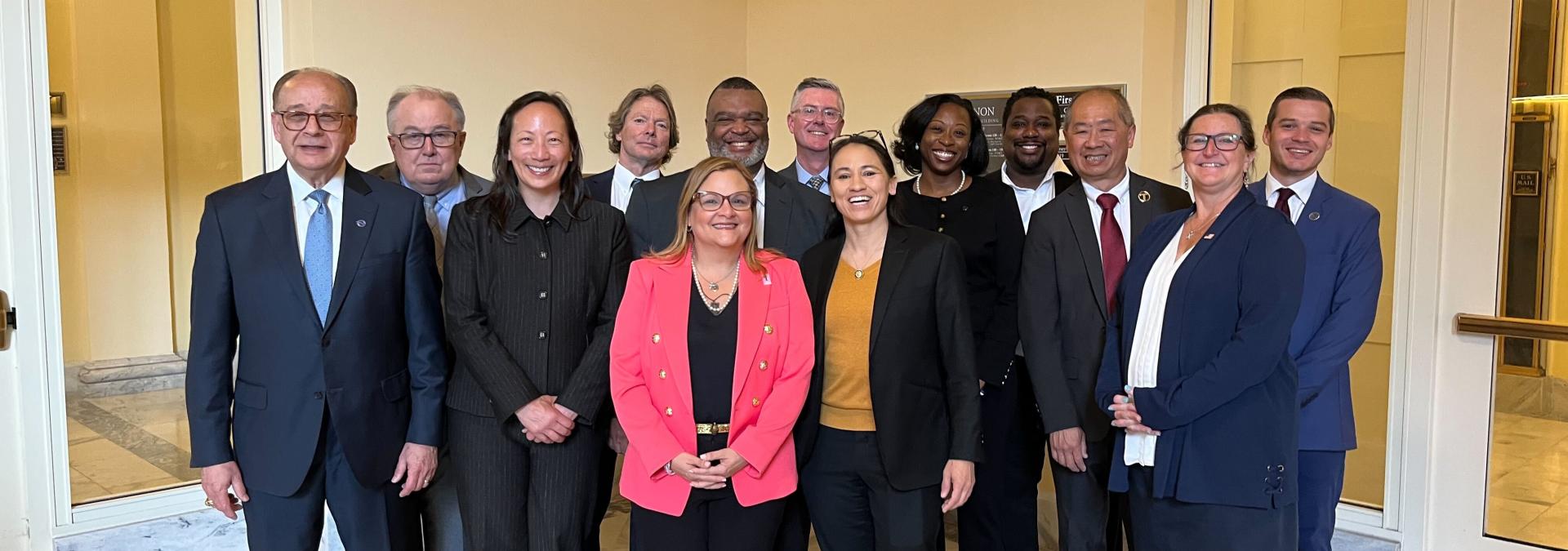
Today, Representative Sharice Davids, founder and co-chair of the bipartisan Congressional FIFA World Cup 2026 Caucus, hosted a Capitol Hill briefing with transit agencies from across the country to highlight the critical role transportation will play in ensuring the success of the 2026 FIFA World Cup.
“The 2026 World Cup is a massive opportunity for our communities. We must be prepared,” said Davids. “That means making sure our transit systems are safe, reliable, and ready to welcome the world. These investments aren’t just about the tournament — they’re a down payment on the future of our cities. I’m excited to keep working with local, state, and federal partners to make sure we get this right and our communities succeed.”
“America is honored to play host to one of the world’s biggest sporting events – the World Cup,” said Representative Buddy Carter (R-GA-01). “In 2026, people from near and far will visit cities nationwide, including Atlanta, to cheer on their teams, and it is essential that communities have the resources to support travelers and keep them safe. This is an opportunity to put our best foot forward and showcase America’s transit system to the entire world, and it’s critical that we have federal support to do just that.”
The discussion brought together representatives from World Cup host cities to share the planning already underway, the anticipated challenges facing their transit systems, and the resources needed from all levels of government. With just more than a year until the tournament begins, the event served as a call to action for coordinated, proactive investment in infrastructure and operations.
The 2026 FIFA World Cup is set to be the largest sporting event in history, with the United States hosting 78 matches over 39 days across 11 cities in 9 states. Each host city will not only manage the matches themselves, but also the daily celebrations and movement of tens of thousands of visitors. To meet FIFA’s requirements, each stadium must be supported by a nearby airport capable of handling at least 1,450 passengers per hour. The economic impact is expected to be significant — generating an estimated 185,000 full-time jobs nationwide, $30.5 billion in gross output, and $17.2 billion in GDP.
“In 411 days, the Kansas City region will host its first 2026 World Cup match,” said Frank White III, President & CEO, Kansas City Area Transportation Authority (KCATA). “It is estimated that 650,000 unique visitors will see for themselves what makes Kansas City so special. And public transportation will be the connection ensuring a memorable fan experience, no matter where you call home.”
“Johnson County, Kansas has been fortunate to be a bit ahead of the curve in preparing for the World Cup by getting vehicles, staffing, and a plan for transit service in place nearly two years before the event,” said Joshua C. Powers, Director, Transit Division, Johnson County. “That said, even with the partnership of our cities, Transportation Authority, and our state government, we know that we absolutely need the support of federal funding to make these plans a reality. The Federal Transit Administration and USDOT have been critical in getting to this point, but without funding for transit operations, we will not be able to respond to the World Cup in the manner the event deserves.”
“Over the next three years, Los Angeles will host dozens of major sporting events and festivals, including the FIFA World Cup in 2026, the Club World Cup this summer, the NBA All Star Game, the Superbowl in 2027, and the Olympic and Paralympic Games in 2028,” said Stephanie Wiggins, CEO, LA Metro. “That means we’ll welcome millions of visitors — on top of the millions of Angelenos who rely on our system every day. It’s imperative that we provide world class service for these global events and leave a legacy of transit improvements that will help our residents thrive after the last whistle is blown. Thank you to the bipartisan Congressional FIFA World Cup 2026 Caucus for convening this important conversation to maximize collaboration, so we can put America’s best foot forward as we welcome the world.”
“We appreciate the U.S. House of Representatives considering transportation funding to help U.S. markets hosting FIFA World Cup events in 2026,” said Michael Morris, P.E., Director of Transportation, Dallas-Fort Worth Metropolitan Planning Organization. “Transit interests from across the country are coming together as an integrated team seeking a financial partnership to maximize the safety and effectiveness of transportation systems to accommodate visitors from across the country and around the world.”
“We have focused relentlessly on rider safety and are ready to offer fans a world-class transit experience,” said Bob Powers, General Manager, San Francisco Bay Area Rapid Transit District (BART). “These efforts include the installation of state-of-the-art fare gates to deter unwanted behavior, the launch of a first-of-its-kind progressive policing bureau, and right-sizing trains to create safer spaces. Our efforts are paying off with a 23 percent drop in violent crime.”
"With seven matches in Massachusetts and many related activities in the Boston area next year, we continue to collaborate closely with host cities across the country in preparation for delivering the robust levels of service needed to ensure the success of this international event," said Phillip Eng, General Manager & CEO, Massachusetts Bay Transportation Authority (MBTA). "By working with our transit partners in other cities, we're striving to make public transportation a consistently reliable and accessible option for people traveling to and from matches and other events."
“The Greater Attleboro Taunton Regional Transit Authority is excited to partner with the Massachusetts Bay Transportation Authority and Rhode Island public transit, along with our fellow Regional Transit Authorities in Massachusetts to showcase how multiple modes of transportation can come together for a successful event,” said Mary Ellen Defrias, Administrator/CEO, Greater Attleboro Taunton Regional Transit Authority (GATRA).
“Federal transit investment is delivering strong returns — modernizing systems, reducing maintenance backlogs, and channeling 77 percent of federal funds to U.S. businesses” said Paul P. Skoutelas, President and CEO, American Public Transportation Association (APTA). “Public transportation plays a key role in cities hosting successful large-scale events like concerts and sports games — driving revenue, creating jobs, and proving transit investments are powerful economic catalysts. The 2026 FIFA World Cup will be the equivalent of hosting 45 Super Bowls within just 39 days across 11 U.S. cities and will require public transit agencies to significantly expand capacity, hours, and safety resources—all of which demands additional funding to maintain reliable service for the 5.8 million fans organizers are expecting."
Along with Davids, speakers at today’s briefing included representatives from the Kansas City Area Transportation Authority, Johnson County Transit, North Central Texas Council of Governments, Dallas Area Rapid Transit, LA Metro, San Francisco Bay Area Rapid Transit District, Greater Attleboro Taunton Regional Transit Authority, Massachusetts Bay Transportation Authority, American Public Transportation Association, and U.S. Department of Transportation (USDOT).
3 p.m. Media Update on IRIS RideShare Service will NOT be Suspended at Midnight
(Kansas City, Mo., April 30, 2025) - KCATA has received notice this afternoon that the city of Kansas City, Mo., will continue to fund the IRIS program. Service will not be discontinued at midnight as previously announced.
More details will be shared when they are available.
Contact:
Cindy Baker, Senior Director Marketing & Communications
816.510.2874 | .(JavaScript must be enabled to view this email address)
KCATA & Adopt-A-Stop Partners Team Up for Earth Day
(Kansas City, Mo., April 17, 2025) – On Tuesday, April 22, 2025, the Kansas City Area Transportation Authority (KCATA) and several Adopt-A-Stop partners will hit the streets to pick up litter at designated bus stops in honor of Earth Day. Adopt-A-Stop is KCATA’s volunteer program to help reduce and prevent littering. KCATA executives, bus drivers and other staff will be on site lending a hand alongside Adopt-a-Stop Partners. Spokespersons will be available at each location.
Participating Partners – Photo Opportunities
|
Ruby Jean’s Juicery |
31st & Troost |
9 - 11 a.m. |
|
City Barrel |
18th & Holmes | 10 - `10:30 a.m. |
|
Pembroke Day School |
Ward Parkway & Baltimore, west side of tennis courts | 9:15 – 9:30 a.m. |
This initiative is part of KCATA’s ongoing Adopt-A-Stop program, which allows businesses, schools and organizations to take an active role in keeping bus stops clean and welcoming for the community.
If you or your organization is interested in adopting a stop, please email .(JavaScript must be enabled to view this email address), call 816-346-0844 or visit https://ridekc.org/planning/adopt-a-stop for more information.
# # #
About KCATA: The Kansas City Area Transportation Authority (KCATA) connects people to opportunities through safe, reliable public transportation. We are a bi-state agency serving and coordinating transit services in seven counties and more than 100 cities across the Kansas City region.
KCATA To Host 2nd State of the KCATA Event at Children’s Mercy Park: Transportation, Area Development & World Cup Discussed
(Kansas City, Mo., March 10, 2025) – On Wednesday, March 12, 2025, the Kansas City Area Transportation Authority will host KCATA’s second State of the KCATA Community Report. It is the goal of the KCATA to share with stakeholders the vision for public transportation in the region and highlight successes and challenges. KCATA is pleased to announce that the 2025 event will be held in Kansas at Children’s Mercy Park from 3-5:30 p.m. at 1 Sporting Way, Kansas City, KS 66111.
“It is an honor to work with so many great individuals and organizations who are dedicated to building a more integrated transportation system throughout our great region,” said Frank White III, KCATA president & CEO. “The State of the KCATA will present our successes and challenges. We’ll illustrate that by working together we can fulfill transit’s promise to provide access to opportunities to all and to be an engine for economic prosperity.”
KCATA will be hosting two panels this year, one on Transit Oriented Community Development (TOCD), and the other on the World Cup 2026. The TOCD panel will feature the following experts in Transit-Oriented Development:
- Allison Bergman, Esq., Senior Principal, Hardwick Law Firm
- Brent Miles, Founding Partner & CMO, NorthPoint Development
- Michael Riley, Director of TOCD/TOD, KCATA
- Brien Starner, Director, Community Development & Real Estate, KCATA
Since Kansas City will be one of the 16 cities hosting the world’s largest sporting event in less than 500 days, there will be a World Cup 2026 panel to address transportation planning that’s underway. Panelists will include:
- Frank White III, President & CEO, KCATA
- Justin Meyer, Deputy Director of Aviation-Marketing & Air Service Department, Kansas City, Mo.
- Deasiray Bush, Director, Unified Government Transportation Department
- Josh Powers, Director, Transit Division, Johnson County Public Works & Infrastructure Department
- Tom Gerend, Executive Director, KC Streetcar Authority
For the first time at this address, the KCATA will be presenting three awards to salute individuals and organizations making a positive difference for public transportation in the Kansas City region. Those award recipients are:
- U.S. Congressional Representatives Emanuel Cleaver II and Sharice Davids will receive the Champion of Transit Award
- Chris Goode, owner of Ruby Jean’s Juicery, will receive the Community Partner Award
- Brent Miles, NorthPoint Development, will receive the Business Partner Award.
The first hour of the event will be a networking opportunity for the KCATA board to visit with regional stakeholders. This event is sponsored by AdSposure and Hardwick Law Firm.
RSVP Requested on Eventbrite at: https://www.eventbrite.com/e/state-of-the-kcata-2025-tickets-1249768664719
The media is invited to interview CEO Frank White III immediately following the event, approximately 5:30pm.
# # #
About KCATA: The Kansas City Area Transportation Authority (KCATA) connects people to opportunities through safe, reliable public transportation. We are a bi-state agency serving and coordinating transit services in seven counties and more than 100 cities across the Kansas City region.
Contact:
Cindy Baker, Senior Director Marketing & Communications
816.510.2874 | .(JavaScript must be enabled to view this email address)
KCATA Announces Public Meeting Dates To Discuss Service Changes
(Kansas City, Mo., March 10, 2025) – The Kansas City Area Transportation Authority (KCATA) will host two public meetings this week to discuss potential service changes. One will be in person; the other will be virtual.
In-Person Meeting
Time: 5-7 p.m.
Date: Thursday, March 13, 2025
Place: East Village Transit Center, 12th & Charlotte (southeast corner)
Virtual Meeting
Time: 12 – 1 p.m.
Date: Friday, March 14, 2025
Link to Join: https://us02web.zoom.us/j/89279181795?pwd=Y5sQkX6bSSRBnOYjp1l0QjNXJTeuJY.1
Proposed service reductions are a result of the increased cost of providing public transit in the post- COVID years and the depletion of federal pandemic funds.
# # #
About KCATA
The Kansas City Area Transportation Authority (KCATA) is managed by a 10-member Board of Commissioners representing seven counties in Missouri and Kansas. It is chaired by Reginald Townsend. KCATA strives to provide a safe, reliable and innovative transportation system that meets the changing needs of metropolitan Kansas City. In addition to providing high quality transit services, KCATA is an employer as well as a partner of business and other community organizations. For more information about KCATA visit [url=https://www.kcata.org/]https://www.kcata.org/[/url]. For rider information visit ridekc.org.
Contact:
Cindy Baker, Senior Director Marketing & Communications
816.510.2874 | .(JavaScript must be enabled to view this email address)
RideKC Prepares for Winter Forecast, Encourages Riders to Plan Ahead
(Kansas City, Mo., Jan. 3, 2025) – RideKC transportation throughout the region is planning for another round of snow and wants transit customers to be aware of possible service interruptions. Winter weather is expected Tuesday-Wednesday, with impacts of snow accumulation and plowing at bus stops. The safety of our operators and customers will drive decisions throughout this winter event. Customers should check frequently for the status of transit service as it may change.
Customers should expect delays on regular fixed-route bus service, and RideKC on-demand services. Depending on the severity of the winter event, adjustments will be made and communicated through RideKC Notify, social media, ridekc.org, call centers and local media.
Riders Should Stay Connected
- This is an ideal time for riders to sign up for RideKC Notify to receive a text, email or voice message about changes affecting specific routes or on-demand services. To sign up for RideKC Notify go here: http://ridekc.alertmedia.com/public
- Web information is available 24/7 at RideKC.org.
- Social media will be updated several times a day throughout the weather event. Follow us on Twitter@ridekctransit or Facebook.com/RideKC or tune into local media.
- The Regional Call Center for RideKC Bus and Streetcar is open Monday-Friday 6 a.m. to 6 p.m. at 816-221-0660. We offer translation assistance for trip information in more than 50 languages.
- RideKC Freedom and on-demand Call Center for paratransit services is 816-842-9070 from 7 a.m. to 4:45 p.m. weekdays and 8 a.m. to 4:45 p.m. weekends.
- IRIS Call Center is 816-205-8221 open 24 hours.
On-Demand Services – Plan Ahead
These are services that customers call and schedule rides or book online. Customers are encouraged to cancel or reschedule non-essential trips early to avoid disruptions. Because this service extends into neighborhoods and side streets, it may take longer for streets to be cleared.
- Expect delays as we prioritize safety first.
- If snowfall exceeds 3 inches, services may be delayed or suspended.
- Clear paths are required. Make sure travel paths are free of snow and ice; we cannot assist with shoveling.
Warming Centers/Buses
RideKC – KCATA’s East Village Transit Center (12th & Charlotte) is open Monday-Friday 8 a.m. to 5 p.m. There is no restroom available.
Most warming centers throughout Kansas City, Mo., and Kansas City, Ks., are served by existing bus routes so customers will have easy access to safe shelter.
Contact:
Cindy Baker, Senior Director Marketing & Communications
816.510.2874 | .(JavaScript must be enabled to view this email address)
Sean Duffy Confirmed as Secretary of Transportation
The Kansas City Area Transportation Authority (KCATA) congratulates Sean Duffy, who was confirmed on Jan. 28 as the 20th secretary of the United States Department of Transportation (USDOT). 
“Transportation is critical infrastructure that forms the foundation of our communities,” said Frank White III, KCATA president and CEO. “We look forward to working with Secretary Duffy to ensure that public transportation remains the backbone of our urban and rural communities and a driver of economic growth and innovation.”
Duffy stated on Jan. 15, “No federal agency impacts Americans’ daily lives and loved ones like the Department of Transportation.” His remarks during his confirmation promised to prioritize safety, balanced with innovation.
RideKC Prepares for Winter Forecast, Encourages Riders to Plan Ahead
(Kansas City, Mo., Jan. 3, 2025) – RideKC transportation throughout the region is planning for winter weather and wants transit customers and the public to be aware of possible service interruptions. Winter weather is expected Saturday–Monday, with impacts possibly lasting into next week. The safety of our operators and customers will drive decisions throughout this winter event. Customers should check frequently for the status of transit service as it may change.
Customers should expect delays on regular fixed-route bus service, and RideKC on-demand services. Depending on the severity of the winter event, adjustments will be made and communicated through RideKC Notify, social media, ridekc.org, call centers and local media.
Riders Should Stay Connected
- This is an ideal time for riders to sign up for RideKC Notify to receive a text, email or voice message about changes affecting specific routes or on-demand services. To sign up for RideKC Notify go here: http://ridekc.alertmedia.com/public
- Web information is available 24/7 at RideKC.org.
- Social media will be updated several times a day throughout the weather event. Follow us on Twitter@ridekctransit or Facebook.com/RideKC or tune into local media.
- The Regional Call Center for RideKC Bus and Streetcar will offer special hours this Sunday from 8 a.m. to 5 p.m. It will operate regular hours Monday-Friday from 6 a.m. to 6 p.m. at 816-221-0660. We offer translation assistance for trip information in more than 50 languages.
- RideKC Freedom and on-demand Call Center for paratransit services is 816-842-9070 from 7 a.m. to 4:45 p.m. weekdays and 8 a.m. to 4:45 p.m. weekends.
- IRIS Call Center is 816-205-8221 open 24 hours.
On-Demand Services
- Plan ahead. Cancel or reschedule non-essential trips early to avoid disruptions. Because this service extends into neighborhoods and side streets, it may take longer for streets to be cleared.
- Expect delays as we prioritize safety first.
- If snowfall exceeds 3 inches, services may be delayed or suspended.
- Clear paths are required. Make sure travel paths are free of snow and ice; we cannot assist with shoveling.
Warming Centers/Buses
RideKC - KCATA will open the lobby of the East Village Transit Center (12th & Charlotte) on Sunday, for this winter event only, from 8 a.m. to 5 p.m. The transit center lobby is not typically open on weekends. Other adjustments to the lobby hours may be made throughout the winter. There is no restroom available.
Most warming centers throughout Kansas City, Mo., and Kansas City, Ks., are served by existing bus routes so customers will have easy access to safe shelter.
RideKC Johnson County Winter Weather Plan: January 4–8, 2025
To ensure the safety of our operators and riders, we are planning for the following weather-dependent service adjustments:
Paratransit Services
- RideKC Freedom and Swift Services: A delayed start is planned for Monday, January 6, at 9 a.m., subject to road conditions. Riders are encouraged to cancel any non-essential trips as soon as possible.
Micro Transit
- Saturday, January 4: Service is scheduled to operate regular hours (6 a.m.- 8 p.m.), weather permitting and subject to change.
- Sunday, January 5: No service on Sundays.
- Monday, January 6: A delayed start at 9 a.m. is planned, but service will only begin if road conditions allow.
Fixed-Route Services
- Conditions will be monitored Sunday, January 5, and any modifications will be posted through the Transit App, RideKC Notify and X (@jocotransit).
Warming Bus at Mission Transit Center
- A warming bus is scheduled to be stationed at the Mission Transit Center on Monday, January 6, from 6 a.m. to 1 p.m., dependent on staffing, vehicle availability and road conditions.
Riders can stay updated in several ways:
- Sign up for RideKC Notify for texts, emails, or voice messages about service changes.
- Follow us on social media: Twitter (@JoCoTransit) and Facebook.
- Check for updates at www.jocogov.org/transit and RideKC.org (regional updates).
- Download the Transit App for real-time updates https://bit.ly/4gW5u9Q
Contact:
Cindy Baker, Senior Director Marketing & Communications
816.510.2874 | .(JavaScript must be enabled to view this email address)
Kansas City Area Transportation Authority Request For Qualifications (RFQ) G24- 6002-08A
Kansas City Area Transportation Authority
Request For Qualifications (RFQ) G24- 6002-08A
Scope of Work For: Architectural, Concept Design & Planning Services for 3827 and 3829 Troost Avenue and Associated Sites
Response Due: November 20, 2024
1. Introduction
Kansas City Area Transportation Authority (KCATA) seeks quotation from qualified firms to provide required labor, insurance, supervision, equipment to successfully perform Conceptual Design Consultant services that include complete facility inspection of existing building and site, review of building plans and associated specific recommendations to include design updates to contemporize the twenty year old building and improvements to both support continued transit and childcare, and recommendations for improvements should the site and building be converted to alternate use such as office.
The work includes review and assessment of the site and building at 3827 and 3829 Troost Avenue, Kansas City Missouri which historically have supported transit and childcare services situated in the northeast quadrant of the intersection of Troost Avenue and 39th Street. The building is approximately 20 + years old and is temporarily occupied by KCATA staff in a few offices on the north end of the building. The property is active under an active RFQ Solicitation for potential childcare and or alternative uses.
Proposers will respond with information outlined below and verify their ability in writing to complete all work in substantial form by January 31, 2025. The building and site have been well maintained, including updates in 2018 and HVAC in May 2023.
2. Scope of Work Objectives
The objectives of this RFQ are to:
- Review of assets, layout and existing conditions and associated recommendations to meet current state and local compliance regulations including:
- Building exterior/interior improvements, site and site assets, signage
- Building and infrastructure obsolescence, substantial wear and or need for updated improvements including efficiency
- Facility requirements to meet state & local regulatory requirements for layout, size and room configuration/student or office staff ratios, and overall facility conditions.
- Facility recommendations to meet safety, security and access including lighting, entrance and exit doors
- Recommend alternatives with conceptual layouts provided that improve the existing floor plan, overall rooms vs common area, and conceptual design layouts that provide for improvements/recommendations for the existing, smaller and larger building footprint.
- Recommend alternate building use(s) beyond childcare and transit that identify1) major challenges for cost/design if present for the alternate use(s); 2) include cost estimates to update layout beyond childcare/transit for office/transit uses. Include specific examples of updates to interior and exterior spaces; and improvements that extend to parking spaces and lighting, building systems that may be required (e.g. including roof, HVAC system; restrooms; lighting, change in adding or taking out walls, etc.)
3. Facility Description
The KCATA transit center at 39th and Troost Avenue Features:
- A designated area for childcare services with parking lot for staff and guests and building of 15,100 sq. ft with the following assets: Eight classrooms including two state certified infant/toddler rooms, three assembly rooms, fully equipped kitchen, and office/reception desk.
- Access to public transit routes and an area at the south end of the building of approximately 845 sq. ft.
- Facilities designed to meet the needs of young children, including fenced playground area, restrooms, and camera and security system measures.
- Five offices are currently used by KCATA and will be available in 2025 as part of the space for lease or sale.
- KCATA is exploring future feasibility of site locations supporting transit linked childcare facility(s) on site or near 2827 NE Vivion Road and associated parcels (the former K-Mart site) and 75th and Prospect Transit Center area.
4. Submission Requirements
Interested parties are requested to review and submit their proposal reflecting the following criteria.
a. Organization Overview:
- Name and address of the organization.
- Contact person, title, phone number, and email address.
- Brief review of relevant work experience of the organization.
- Licenses, certifications and experience relevant to proposed services.
b. Operational Timeline:
- Proposal Deadline: November 20, 2024, 4:00 pm
- Review and selection of awardee: November 28th followed by exchange, review and execution of KCATA standard professional services contract term and conditions.
- Meet with KCATA prior to commencement of scope of work on November 18th, 2024
- Zoom Meeting with KCATA staff to review work status January 3, 2025
- Completion of draft final report and draft final invoice of work completed to date: Due January 22nd, 2025
- Final report & invoice due to KCATA January 31, 2025.
c. Financial Terms:
- This proposed Scope of Work is a “lump-sum, single payment”.
- Proposer will itemize staff hours, billable rates for personnel, associated outside services including information, research, scope of work costs will be provided in both the draft and final invoices.
- This RFQ is a “Not-To-Exceed” $50,000.00 budget for all deliverables to deliver essential project elements supported by hours and quoted hourly rate and associated costs.
d. Previous Experience:
- Examples of similar projects and experience performed by the organization.
- References from previous or current clients.
5. Submission Process
Interested parties should send their responses electronically to .(JavaScript must be enabled to view this email address) by 4:00 pm, November 20, 2024, .(JavaScript must be enabled to view this email address). Submissions will be reviewed by the KCATA selection committee and determinations made regarding potential interviews and/or further discussions.
6. Evaluation Criteria
- Responses will be evaluated based on the following criteria:
- Experience and qualifications of the organization to perform proposed work including architectural, planning and design concepts.
- Price, quality and comprehensiveness of proposed matching services.
- Ability to deliver final draft product by January 31, 2025 not exceeding the budget, timeline and scope.
- Alignment to KCATA’s guiding goal of concept, design and planning focused around transit and childcare that incorporate KCATA’s 39th and Troost Avenue Facility and alternate site locations.
- References and past performance.
7. Restricted Communications
No person or entity submitting a proposal in response to this Request for Information, nor any officer, employee, agent, representative, relative or consultant representing such a person (or entity) may contact through any means, or engage in any discussion concerning the award of this contract with any member of KCATA’s Board of Commissioners or any employee of KCATA (excluding the personnel listed in this RFI) during the period beginning on the date of proposal issue and ending on the date of the selection of a Contractor. Any such contact may be grounds for disqualification of the Proposer.
8. KCATA Point Of Contact Information
All proposal responses shall be delivered by electronic email and flash drive by deadline. For any questions or further information regarding this RFQ, please contact:
Brien Starner - Director, Community Development & Real Estate
KCATA
1200 E. 18th Street
Kansas City, MO 64108
816-918-9947
.(JavaScript must be enabled to view this email address)
The KCATA Wants to Hear Your Story
At KCATA, we’ve always known public transportation is bigger than the bus. In our view, as the region’s largest public transportation system, transportation has the power of transformation — in more ways than one.
In an effort to highlight that transformation, we're creating a video featuring our most important customer...you!
If you're a rider, we’d love for you to share why KCATA and RideKC are important in your life. Whether it's helping you get to work, school, childcare, or so much more, your perspective is important so we can continue to get you where you need to go.
After completing the form below, our team will review, and a select few will be invited to participate in a brief video shoot. Due to editing limits, there’s no guarantee your footage will be used.
Thanks for riding!
KCATA Statement on Hurricanes Milton and Helene
On behalf of the 1,000 regional transit employees in the Kansas City metro area, our thoughts are with the people and communities impacted by hurricanes Milton and Helene. In challenging times like this, public transportation is crucial to providing essential mobility. We all stand united in efforts to support our transit brothers and sisters, who are going above and beyond for the people who depend on them the most.
Frank White, III
President & CEO
Kansas City Area Transportation Authority
Notice of Bond Sale
NOTICE OF BOND SALE
$8,660,000
(Maximum Principal Amount)
Kansas City Area Transportation Authority
Sustaining Transportation and Reinvesting Together
Taxable Revenue Bonds
(Mabion Facility)
Series 2024 B
Sealed proposals for the purchase of $8,660,000 maximum aggregate principal amount of Taxable Revenue Bonds (Mabion Facility), Series 2024, of the Kansas City Area Transportation Authority (the “KCATA”), will be received by the President and CEO of the KCATA at 1200 East 18th Street, Kansas City, Missouri 64108 until 5:00 P.M., Central Time on Tuesday, September 17, 2024.
The KCATA has prepared an Official Bid Form, a copy of which may be obtained from the President and CEO. The purchaser(s) of the Taxable Revenue Bonds (Mabion Facility), Series 2024 (or its parent, controlling party, members, owners or guarantors) shall be “Accredited Investors” as defined in Rule 501 of Regulation D promulgated under the Securities Act of 1933 and “Qualified Institutional Buyers” as defined in Rule 144A or the Company (as defined in the Notice of Bond Sale). Additional information regarding the bid and sale of the Taxable Revenue Bonds (Mabion Facility), Series 2024, may be obtained from the President and CEO at (816) 346-0200.
KANSAS CITY AREA TRANSPORTATION AUTHORITY
By: Frank White III, President and CEO
Date: September 9, 2024
DT Williams Rocks and Rolls Legacy Transit Career
When David Williams was first hired at the Kansas City Area Transportation Authority (KCATA) he probably had a pretty good idea it was going to be a career. After all, his grandfather, father and uncle collected over 120 years as streetcar and/or bus operators. And sure enough, despite pursuing his musical pursuits in between, DT has now been with KCATA nearly 30 years and still going strong. Rocking and rolling all day long. Check out this video profile of Instructor David Williams.
KCATA Vice-Chair Jason Sims Joins KC2026 Team
 (Kansas City, Mo., July 25, 2024) – The Kansas City Area Transportation Authority (KCATA) congratulates Jason Sims, KCATA Board vice-chair, on his selection as Director of Transportation for KC2026. KC2026 Press-Release With more than 23 years of experience in the transportation industry, Sims is an established and respected leader in traffic management operations, safety, congestion mitigation and system development. Sims is credited with providing the operational vision for and led the development of the Kansas City Scout Traffic Management Center, which has served the bi-state region of Kansas City since 2003. Sims was appointed to the KCATA Board of Commissioners January 27, 2022, representing Wyandotte County, Kans. He will continue to serve in his Vice-Chair capacity.
“It is truly an honor to serve in this role for KC2026, and I am looking forward to contributing to a world-class regional transportation experience for the World Cup,” said Sims.
“Commissioner Sims has been a steadfast leader on the KCATA Board of Commissioners,” said Frank White, III, KCATA CEO. “His expertise, leadership and critical thinking will be a true asset to the KC2026 team. We are grateful for his service on our board.”
About KCATA
The Kansas City Area Transportation Authority (KCATA) is managed by a 10-member Board of Commissioners representing seven counties in Missouri and Kansas. It is chaired by Reginald Townsend. KCATA strives to provide a safe, reliable and innovative transportation system that meets the changing needs of metropolitan Kansas City. In addition to providing high quality transit services, KCATA is an employer as well as a partner of business and other community organizations. For more information about KCATA visit https://www.kcata.org/. For rider information visit ridekc.org.
Contact:
Cindy Baker, Senior Director Marketing & Communications
816.510.2874 | .(JavaScript must be enabled to view this email address)
Notice of Bond Sale
NOTICE OF BOND SALE
$79,000,000
KANSAS CITY AREA TRANSPORTATION AUTHORITY
TAXABLE REVENUE BOND
(ASCENT APARTMENTS FACILITY)
SERIES 2024
Sealed proposals for the purchase of $79,000,000 maximum aggregate principal amount of Taxable Revenue Bond (Ascent Apartments Facility), Series 2024, of the Kansas City Area Transportation Authority (the “KCATA”), will be received by the President and CEO of the KCATA at 1200 East 18th Street, Kansas City, Missouri 64108 until 5:00 P.M., Central Time on Tuesday, July 23, 2024.
The KCATA has prepared a Notice of Bond Sale Form and an Official Bid Form, copies of which may be obtained from the President and CEO. The purchaser(s) of the Taxable Revenue Bond (Ascent Apartments Facility), Series 2024, shall be limited to “Accredited Investors” as defined in Rule 501 of Regulation D promulgated under the Securities Act of 1933 and “Qualified Institutional Buyers” as defined in Rule 144A or the Company (as defined in the Notice of Bond Sale). Additional information regarding the Taxable Revenue Bond (Ascent Apartments Facility), Series 2024, and the sale may be obtained from the President and CEO at (816) 346-0200.
KANSAS CITY AREA TRANSPORTATION AUTHORITY
By: Frank White III, President and CEO
KCATA Congratulates Johnson County on $7.65M Grant
(Kansas City, Mo., July 9, 2024) – Today, the Federal Transit Administration (FTA) announced the recipients of the FY 24 Bus and Low- & No-Emissions Grant awards. The Kansas City Area Transportation Authority (KCATA) congratulates Johnson County Government on the receipt of a $7.65 million Bus and Bus Facilities grant to buy new energy-efficient propane and CNG vehicles that will replace diesel-powered vehicles that have exceeded their useful life. The announcement was made today at an event in Johnson County.
“Congratulations to our partners at Johnson County on the receipt of this $7.65 million grant,” KCATA Chief Executive Officer Frank White, III said. “Through this investment, Johnson County will be able to modernize their bus fleet, provide riders a smoother trip and reduce impacts on the region’s air quality. It’s always a good day when federal transit dollars come to the region.”
About KCATA
The Kansas City Area Transportation Authority (KCATA) is managed by a 10-member Board of Commissioners representing seven counties in Missouri and Kansas. It is chaired by Reginald Townsend. KCATA strives to provide a safe, reliable and innovative transportation system that meets the changing needs of metropolitan Kansas City. In addition to providing high quality transit services, KCATA is an employer as well as a partner of business and other community organizations. For more information about KCATA visit [url=https://www.kcata.org/]https://www.kcata.org/[/url]. For rider information visit ridekc.org.
Contact:
Cindy Baker, Senior Director Marketing & Communications
816.510.2874 | .(JavaScript must be enabled to view this email address)
Press Release: KCATA Strategic Plan

inFOCUS Five-Year Strategic Plan Charts Path for KCATA Success
June 26, 2024 (Kansas City, Mo.) — Today the Kansas City Area Transportation Authority (KCATA) publicly released its inFOCUS Strategic Plan (pdf), a five-year outlook that serves as a blueprint for success and a renewed dedication to the agency’s mission to connect all people to opportunities.
KCATA is one of the few bi-state authorities in the country. As such, it has developed a strategic plan in response to the region’s current and future mobility needs, setting an ambitious agenda to keep the agency at the forefront of transportation leadership through 2030 and beyond. The acronym FOCUS represents the plan’s five strategic goals: 1) Finance; 2) Organization; 3) Customer Experience; 4) Unified Region; and 5) System Development.
“Our commitment to excellence has always been at the core of our mission,” KCATA Chief Executive Officer Frank White, III said. “The vital job of connecting all people to opportunities doesn’t stop at state, county or municipal borders. As the bi-state agency that transcends those boundaries we don’t take that responsibility lightly.”
The KCATA Board of Commissioners adopted the plan in February, charging CEO White, the executive leadership team and themselves with implementation starting with the FY 2025 budget year.
A Collaboratively Developed Plan
inFOCUS represents a phased approach and was developed collaboratively by the agency and KCATA’s Board of Commissioners with input from local and regional stakeholders, outlining how the agency can better adapt to the needs of the region.
"Moving people is at the heart of what we do and by prioritizing reliability, accessibility and safety, we are committed to developing a transit system that strengthens public confidence and promotes greater mobility options," Chairman Reginald Townsend stated. “inFOCUS is the framework of our commitment to develop a world-class multimodal system. My fellow commissioners and I look forward to working with regional partners to turn this vision into reality for our customers and other stakeholders.”
KCATA convened industry experts, held conversations with leaders across the region, solicited feedback from all levels within the organization, and surveyed stakeholders to better understand viewpoints. The result was a strategic plan that responds to local, regional and national trends and challenges. This includes a rapidly growing region and a need for new funding sources, greater regional service delivery, pandemic shifts in consumer travel patterns, and evolving workforce trends.
The plan also recommends KCATA support the region’s preparations for the 2026 FIFA World Cup. Oversight of strategic plan implementation is tasked to Commissioner Julie Lorenz, who previously served as Kansas Secretary of Transportation. She is also serving as Senior Advisor for Transportation for KC2026, the nonprofit organization in charge of planning and executing the World Cup.
“The inFOCUS plan provides a vision for improved mobility for all. This is most important as one of only 11 U.S. cities hosting 2026 FIFA World Cup matches, providing us an exceptional opportunity to showcase Kansas City on a global stage,” Lorenz said. “Thousands of people will be visiting for the first time, and our successful accommodation of those guests means they need to be able to navigate our region seamlessly. My hope is that the region will come together to support this strategic plan as a meaningful step toward the goal of developing a regional, multimodal system that serves us now, for the World Cup, and into the future.”
Refreshed Vision, Mission, Goals and Core Values
The inFOCUS strategic plan presented an opportunity for KCATA to refresh its vision and mission statements, core values and goals.
Vision: Enhance lives in our region through reliable and convenient mobility options.
Mission: Connect all people to opportunities.
Core Values: Safety and Security, Customer Focus, Respect and Integrity, Fiscal Sustainability, Collaboration
Goals/Major Initiatives: The outcome of the inFOCUS plan is a program of strategies and initiatives that help further KCATA’s five strategic goals:
- Finance – To be fully financially sustainable with dedicated funding sources.
- Organization – Strengthen the engaged and empowered workforce.
- Customer Experience – Provide reliable, convenient and equitable mobility alternatives.
- Unified Region – Support a thriving region through environmental sustainability, development and access to opportunity.
- System Development – Collaboratively lead the region in delivering mobility options.
Through inFOCUS, KCATA strives to be the regional integrator of mobility solutions. This will be done through a holistic emphasis on the entire passenger experience and coordination across the region.
To learn more, download the full report at https://www.kcata.org/inFocus
About KCATA
The Kansas City Area Transportation Authority (KCATA) is managed by a 10-member Board of Commissioners representing seven counties in Missouri and Kansas. It is chaired by Reginald Townsend. KCATA strives to provide a safe, reliable and innovative transportation system that meets the changing needs of metropolitan Kansas City. In addition to providing high quality transit services, KCATA is an employer as well as a partner of business and other community organizations.
For more information about KCATA visit https://www.kcata.org/. For rider information visit https://ridekc.org.
Downloads
Ride KC Celebrates 1st Year of Adopt-a-Stop Program
(Kansas City, Mo., April 29, 2024) – The Kansas City Area Transportation Authority (KCATA) and partners are taking an active role in improving Kansas City communities with the RideKC Adopt-A-Stop program which kicked off one year ago on Earth Day. The first organization to step up was Ruby Jean’s Juicery at 31st Street and Troost Avenue. Now, there are 13 partners in the Adopt-A-Stop program.
Members who adopt a stop are responsible for picking up litter at “their” adopted stop at least once a week, or as needed to maintain the bus stop’s aesthetic condition. In exchange, participants will receive a sign at the bus stop with the individual’s or organization’s name recognizing their volunteer work.
“We work with great community partners that help support the public transportation system,” said Frank White, III, president & CEO of KCATA. “Everyone benefits from their efforts to make bus stops cleaner, safer and more accessible.”
KCATA is making strides for greener, cleaner public transportation in a variety of ways:
Expanding the volunteer-led Adopt-a-Stop program to 13 participating partners who help keep transit stops litter-free.
Expanding its fleet of low- and no-emission vehicles. 60% of the fleet is currently Compressed Natural Gas (CNG). There are currently three battery electric buses with more to be ordered.
Modernizing the bus system and installing electric charging infrastructure.
More about KCATA’s Adopt-A-Stop program:
If you or your organization is interested in adopting a stop, please email .(JavaScript must be enabled to view this email address), call 816-346-0844 or visit https://ridekc.org/planning/adopt-a-stop for more information.
UG Launches Flexible, On-Demand Transportation Service to Improve Connectivity and Community Access
Kansas City, KS – The Unified Government of Wyandotte County and Kansas City, KS (UG) Transportation Department has launched an innovative new microtransit and paratransit service to provide passengers with more efficient, responsive public transportation in our community. The IRIS application, provided by RideCo, is a cloud-based service that enables riders to improve their overall experience in planning, reserving, and paying for their rides in a single application. Both services operate under the RideKC brand.
Paratransit is an auxiliary service that provides an equitable origin-to-destination alternative to fixed-route public transportation services. Eligibility is determined by a person’s functional inability to travel to or from a bus stop, get on or off a ramp-equipped bus, or safely travel to and from a destination due to a disability. Microtransit is an on-demand shuttle service that operates within specified zones, connecting fixed route transit lines to large employers and other key destinations in Wyandotte County and is available to any community member.
“IRIS allows us to improve performance and service, identify driver trends, increase shared rides, and ensure on-time performance,” said Transportation Director Deasiray Bush. “We are encouraged by the initial feedback on the quality of these services as more equitable transportation options in our community.”
With the IRIS app, riders can now request same-day service for rides with either paratransit or microtransit services. Paratransit services are available throughout Wyandotte County. Microtransit services have been launched in Midtown KCK and Southwest Edwardsville with plans to introduce an additional service area in the Northeast/Fairfax area later this year.
“Teaming up with the Unified Government, we're enthusiastic about our role in modernizing the paratransit service," stated Prem Gururajan, Co-Founder and CEO of RideCo. "Our partnership ensures riders receive the high-quality service they've come to expect, now with the added convenience of on-demand accessibility. RideCo's cutting-edge technology has streamlined operations behind the scenes, enhancing overall efficiency.”
Microtransit services are $3.00/ride and can be paid through the IRIS mobile application, IRIS booking website, or by calling UG Transportation Dispatch at 913-573-8351. Riders can apply to be pre-qualified for paratransit service by calling 816-842-9070 or submitting the online form to the UG Transportation Department and KCATA. Paratransit services are currently FREE. More information about both services can be found wycokck.org/Transportation.
About UG Transportation: The Unified Government Transportation Department offers multimodal transit services such as fixed routes, microtransit services, and paratransit. We operate under the RideKC regional brand as we collaborate and contract with the Kansas City Area Transportation Authority (KCATA) for additional services and coordinate with other regional transit providers to make the transit experience user-friendly for everyone.
About Ride Co.: RideCo is the leader in rider-centric on-demand transit technology, with the most adopted cloud-based paratransit and microtransit solution among the 10 largest cities in the United States. Trusted by agencies, as well as fleet operators and technology companies, the platform powers the largest on-demand transit services in North America including Los Angeles and Philadelphia. Houston and San Antonio have also adopted RideCo’s transformative software, rooted in proprietary continuous optimization technology, and supported by the industry’s best customer service, including a 95% plus retention rate.
NEXT STOP: THE KANSAS CITY RIVERFRONT Crews to Break Ground on the KC Streetcar Riverfront Extension
KANSAS CITY, Mo. (February 22, 2024) – Exciting things are happening on the Riverfront and on Friday, March 1, Kansas City will celebrate one more addition – the KC Streetcar.
Kansas City is invited to take part in the groundbreaking for a monumental transportation project that will completely transform how the community connects to the Riverfront. Join with project partners – City of Kansas City, Kansas City Area Transportation Authority (KCATA), Kansas City Streetcar Authority (KCSA), and PortKC- as they get ready to mark the start of construction for the KC Streetcar Riverfront Extension. This momentous event will kick off the $61 million project, setting the stage for a new era of connectivity, showcasing Kansas City’s commitment to investing in infrastructure that benefits residents, businesses, and visitors.
WHAT: KC Streetcar Riverfront Extension Groundbreaking Ceremony & Community Open House
WHEN: Friday, March 1, 2024, at 10:00 am
WHERE: Riverfront Drive and Berkley Plaza (just north of the Port KC offices at 110 Berkley Plaza) Attendees are encouraged to carpool, bike, or take public transit to the event. RideKC Route 210 Front Street serves the Riverfront, with about a 5-minute walk.
Following the ceremony, there will be a community open house at the Port KC office, providing an opportunity for residents, businesses, and stakeholders to meet the construction team, engage with project leaders, and learn more about this transformative project.
The KC Streetcar Riverfront Extension will cover 0.7 miles, connecting from the streetcar line at 3rd & Grand to the midpoint of Berkley Riverfront Park, and just steps away from CPKC Stadium. The project is made possible through a collaborative public and private partnership and funded with a combination of federal and local dollars: $35.2 million in federal funding and $25.9 million in local funding.
For more information about the KC Streetcar Riverfront Extension construction, please visit http://riverfrontkcstreetcar.com or find the team online on X (@kcriverfront), Instagram (@kcriverfront), and Facebook (@kcstreetcarriverfront). Contact the construction team by email at .(JavaScript must be enabled to view this email address)
MEDIA: Project team members will be available for media opportunities Friday, February 23 and the week of February 26, 2024.
For questions, please contact Donna Mandelbaum with the KC Streetcar Authority at 816.877.3219 (cell) or email at .(JavaScript must be enabled to view this email address) or Cindy Baker with the KCATA at 816.510.2874 (cell) or email at .(JavaScript must be enabled to view this email address). The KC Streetcar is also online at www.kcstreetcar.org and on Twitter (@kcstreetcar), Facebook (@kcstreetcar) and Instagram.
RideKC Transit Official Statement

RideKC Official Statement Regarding the Recent Tragedy
Yesterday started out full of celebration and comradery as RideKC Transit (Streetcar, Bus, and Bike) carried thousands of excited fans to the Chiefs Super Bowl Parade and Rally. Unfortunately, things took a tragic turn, resulting in the heartbreaking death of one Kansas Citian and injuring at least 22 others, including innocent children. Our thoughts and deepest condolences go out to the victims, their families, and all those affected by the senseless act of gun violence that transpired that day.
The Ride KC Transit team joins our City, and our entire community, in mourning this shattering loss, and we stand united in our commitment to fostering a safe and secure environment for everyone who utilizes Kansas City’s public transportation services. We recognize that events like this impact the fabric of our society, causing grief and leaving lasting scars on the affected families and the community at large.
Gun violence has become an insidious epidemic, affecting communities nationwide and leaving a trail of devastation in its wake. It is incumbent upon us, as responsible stewards of public safety, to recognize the urgency of this issue and collectively work towards lasting solutions.
Our commitment to creating a safe community extends beyond our transit services. We pledge to work collaboratively with our passengers, neighbors, and City, County, and elected officials to ensure that our shared spaces are secure and welcoming. Together, we can cultivate an environment where everyone feels protected, supported, and free from the threat of violence.
RideKC Shuttles to the Chiefs Parade
The Chiefs Kingdom Champions Parade will be held in downtown Kansas City on Wednesday, Feb. 14th. The parade begins at 11am, with the Rally following at approximately 12:45pm. The Parade Shuttles will serve fans at five free Park & Ride locations.
See the complete schedule and shuttle locations at RideKC.
Cyber-Attack hits KCATA. Communications affected.
A ransom cyber-attack hit the KCATA early Tuesday, January 23. We have contacted all appropriate authorities including the FBI.
All service is operating, including fixed-route buses, Freedom and Freedom-On-Demand paratransit service.
The primary customer impact is that regional RideKC call centers cannot receive calls, nor can any KCATA landline. Freedom and Freedom-On-Demand Paratransit customers should call these numbers to schedule a trip:
- KCMO & Independence - 816-512-5563
- Wyandotte County - 913-573-8351
- Johnson County - 913-362-3500
Fixed-route bus customers can log on to RideKC.org or use the Transit app for bus schedule information.
KCATA is working around the clock with our outside cyber professionals and will have systems back up and running as soon as possible.
Voters Say YES to Bus Tax Renewal
(Kansas City, Mo., Nov. 8, 2023) – Kansas City voters say yes to the Kansas City Area Transportation Authority (KCATA) and the 3/8-cent sales tax for the next 10 years.
“Thank you to the voters of Kansas City for once again renewing this critical transit tax to keep our buses rolling,” said Frank White, III, KCATA president and CEO. “If there was ever any doubt about the broad-based community support for public transportation in Kansas City, it was eliminated by a margin of 73% yesterday.”
The 3/8-cent sales tax supports approximately 30% of the RideKC bus system in Kansas City, Mo. The sales tax was originally passed by KCMO voters in 2004. It was renewed in 2008 for 15 years and is set to expire in March 2024.
More than 1 million trips are taken on RideKC every month.
“We would like to thank our many supporters who worked on behalf of this ballot initiative, beginning with our labor partners ATU 1287,” White said. “Our union brothers and sisters, along with many other advocates, worked every day for the last few weeks ensuring people understood that failure was not an option.”
Contact: Cindy Baker cbaker@kcata.org for media inquiries
KCATA Welcomes Two Industry Leaders to Board of Commissioners
KCATA Welcomes Two Industry Leaders, Julie Lorenz & Bridgette Williams, to Board of Commissioners
(Kansas City, Mo. | October 24, 2023) The Kansas City Area Transportation Authority (KCATA) is pleased to announce two new members of the 10-person Board of Commissioners. Julie Lorenz, who joined the governing body in June 2023, represents Johnson County, and Bridgette Williams, who joined in October 2023, represents Wyandotte County.
Julie Lorenz
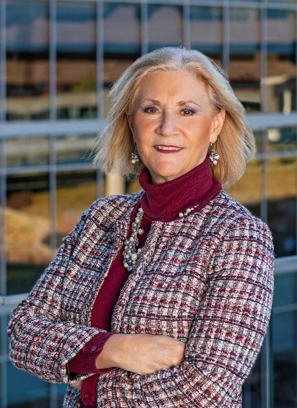
Julie was appointed Secretary of KDOT and Director of the Kansas Turnpike Authority in January 2019. While at KDOT, she launched the Kansas Infrastructure Hub in support of IIJA, spearheaded the development and passage of the $10 billion Eisenhower Legacy Transportation Program and led the Kansas Recovery Office, responsible for administering over $1billion in CARES Act COVID-19 relief funding in six months. She was honored to receive the George S. Bartlett Award for leading development of a national vision for transportation for state DOTs, which was unanimously approved by all 52 state and territory departments of transportation in October 2022.
Ms. Lorenz joined 1898 & Co., the business and technology consulting arm of Burns & McDonnell, as a principal consultant in January 2023. With more than 25 years of experience, she’s known as a national leader in policy development, collaboration and implementing vision initiatives.
“I am very honored to represent Johnson County and contribute my knowledge and experience in this meaningful way,” said Lorenz. “I believe in regionalism, serving a public sector mission and working on challenging problems through collaboration, which makes this appointment a good fit. There are game changing opportunities for transit in the region.”
Bridgette Williams
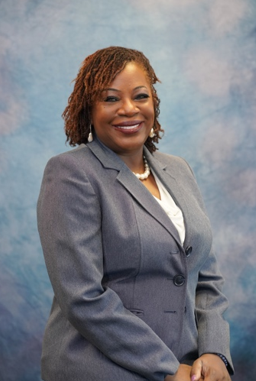
Bridgette Williams serves as Executive Director of the Heavy Constructors Association of Greater Kansas City. As the Executive Director of the Heavy Constructors, Williams is the first African American and the first female to hold the top position in an AGC chapter in the country.
Founded in 1950, the Heavy Constructors Association has been at the forefront of transportation, public works, infrastructure issues, and campaigns in the Greater Kansas City Area, and in the states of Kansas and Missouri. Ms. Williams has over 30 years of experience in the fields of transportation, construction, economic development policy, problem-solving, contract negotiations, and people management. She began her career right out of college as a part-time receptionist at the Greater Kansas City AFL-CIO. She worked in various positions within the organization.
Ms. Williams was elected President of the Greater Kansas City AFL-CIO and served in that capacity for over 15 years. She was the first African American, the first female, and the youngest elected to the position in the country. The Greater Kansas City AFL-CIO is the umbrella organization for all Organized Labor in the Greater Kansas City area representing over 100,000 working men and women.
“Easily accessible, reliable and affordable transportation is the lifeblood of our region,” said Ms. Williams. “I fully embrace the KCATA’s mission to provide equitable access to jobs, education, medical care and housing. I’m honored to represent the great people of Wyandotte County in this capacity and to bring a diverse set of skills and experience to the table.”
Commissioners are limited to two consecutive four-year terms.
Contact: Cindy Baker .(JavaScript must be enabled to view this email address) for media inquiries
KCATA Issues Transit Oriented Community (TOC) Request for Qualifications (RFQ)
RFQ ISSUED: Addendum #2
This New Release reflects Addendum #2 that has been updated for proposing parties to review regarding updates to the calendar and timeline for RFQ responses that can be found on links below.
The Kansas City Area Transportation Authority (KCATA) and RideKC Development Corporation (RKCDC) issued a Transit Oriented Community (TOC) Request for Qualifications (RFQ) soliciting Development Team and Concept proposals tailored to TOC development outcomes for a 16.44 acre property at 2821 Vivion Road, and associated parcels.
The Pre-Proposal Conference held by RideKC Development Corporation and the Kansas City Area Transportation Authority has been changed from April 20th and will be held now April 24th, 2023 from 11:00 am to 1:00 pm at the offices of NNI, located at 5340 N. Chouteau Trafficway, Kansas City, Missouri 64119.
Please click the link below or scan the QR Code to access to the RFQ, and associated Attachments and updated Timeline, including Zoom Webinar to inform and guide parties to submit their response to the RFQ. Questions will be taken in writing and are subject to being shared with all public and responding parties.
Link: https://drive.google.com/drive/folders/1MuAPnHArBe-YnH-ymM-9xZm6Lv7x6Xdd?usp=share_link
RideKC Shuttled 70,000 Chiefs Fans to Parade
Could Nearly Fill Arrowhead Stadium
(Kansas City, Mo., February 22, 2023) – The Kansas City Area Transportation Authority (KCATA) is pleased to announce that regional RideKC transit shuttled more than 70,000 to and from five park-and-rides to the Chiefs Kingdom Champions Parade. That’s enough to nearly fill Arrowhead Stadium! This compares to 55,000 in 2020. Shuttle service was provided before and after the parade and rally from:
- HyVee Arena (KCMO)
- Worlds of Fun (KCMO)
- Oak Park Mall (Johnson County)
- 47th & State Transit Center (Kansas City, Kan.)
- Swope Park/Zoo Parking Lot (KCMO/Jackson County)
The busiest park and rides were Oak Park Mall and Worlds of Fun, providing more than 40,000 trips combined.
“Public transportation is the lifeblood of our community,” said Frank White III, CEO of KCATA. “In times of celebration and in times of challenge, RideKC connects people to opportunities, like jobs, education, health care, housing, and yes, Super Bowl Parades.”
The successful shuttle service was made possible by regional RideKC operators and by contracting with local school bus companies. Approximately 130 public transit buses and 300 school buses were deployed. In addition to the shuttles, KCATA-RideKC served even more parade-goers on buses that replaced KC Streetcar service that was not operating during the parade.
“Special event transportation is often the first introduction to public transportation in a city like Kansas City,” said White. “RideKC drivers and staff thrive on these opportunities to put our best foot forward. When special event customers have a champion experience, they will come back for more."
# # #
RideKC East-West Transit Study Progresses Forward
Second Round of Public Meetings Scheduled for the RideKC East-West Transit Study
(Kansas City, Missouri | Jan 31, 2023) - The Kansas City Area Transportation Authority (KCATA) and KC Streetcar Authority (KCSA), in cooperation with several project partners, announce the next round of public meetings for the RideKC East-West Transit Study.
During these meetings, the project team will introduce proposed transit scenarios, including routes and modes, for the RideKC East-West Transit Study. There will be in-person presentations and a question-and-answer session for the public to provide feedback. The same information will be presented at both meetings.
Tuesday, February 7, 2023
Presentations start at 5 p.m. and 6 p.m.
Habitat for Humanity of KC, 1423 Linwood Blvd., Kansas City, MO 64109
Thursday, February 9, 2023
Presentations start at 6 p.m. and 7 p.m.
Our Savior Lutheran Church, 4153 Rainbow Blvd., Kansas City, KS 64103
Public feedback is critical to ensure the future of high-capacity transit in Kansas City is equitable and transformative. Since the study began in April 2022, the project team has conducted more than 150 one-on-one or in-person micro meetings, held three public meetings, and issued two community surveys to gain feedback from the community about their transit needs.
This study is unique because it’s a multi-party, bistate effort to analyze the technical and financial feasibility of high-capacity east-west transit connections across the state line. The corridor includes connections to the KC Streetcar Main Street Extension as well as north-south RideKC MAX Bus Rapid Transit and bus services on both sides of the state line. Building on previous studies which have identified specific corridors as potential transit opportunities, the project study area is from Rainbow Boulevard to the west and the Truman Sports Complex to the east, and 31st Street to the north and 43rd Street to the south.
RideKC East-West Transit Study project partners include the Kansas City Area Transportation Authority (KCATA); the Kansas City Streetcar Authority (KCSA); the City of Kansas City, Mo. (KCMO); Unified Government of Wyandotte County and Kansas City, Kansas (UG); and the University of Kansas Hospital Authority.
###
MEDIA: For East-West Transit study questions, please contact Alex Miller at alex@parsonkc.com or by phone at 816-601-0137. To learn more about the RideKC East-West Transit study, visit the project webpage at www.eastwesttransit.org.
KCATA Announces Frank White III as CEO – no longer interim – to Lead Bi-State Authority
(Kansas City, Mo. | Jan. 25, 2022) The Kansas City Area Transportation Authority (KCATA) is pleased to announce Frank White III, as the permanent President and CEO.
In August of 2022, White was unanimously named to the interim CEO position by the 10-member KCATA Board of Commissioners. With this new appointment, he is the first African-American to lead the organization as CEO.
In the past six months as the interim CEO, White has worked to add transparency to operations, as well as a deeper integration of data and analytics. He has sought out and engaged experts in mobility, land use, transit data and economic activity in order to drive innovation across the agency. At RideKC Development Corporation, White continues to be instrumental in engaging the community and building relationships to create a transportation-oriented development model that fits the region’s unique needs.
Additional select achievements over the last six months include:
- Hiring and promoting talent from within the organization
- Hiring over 100 new bus operators, which will help with service delivery
- Being the first CEO to speak at the Amalgamated Transit Union (ATU)
- Negotiating a new contract with ATU
- Planning for a major safety initiative that will be implemented in 2023
- Having partnership conversations with major employers in the region
- Reaching out to strengthen and create new connections with both local and federal elected officials and leaders
“Frank has proven he’s the right leader for the job,” says Melissa Bynum, Chair of the KCATA Board of Commissioners. “His vision, commitment and tenacity has fueled new life into the organization, not to mention his qualifications are spot on. The board is aligned with Frank’s leadership approach and we look forward to working with him to achieve KCATA’s mission.”
Frank was hired at KCATA in 2016 as a Senior Marketing Manager and quickly ascended the ranks of the agency, including roles of Chief Marketing Officer, Director of Strategic Planning and Development, and Vice President of RideKC Development Corporation. Across these roles, White led the agency to award winning work in both marketing and diversity. He accelerated expanded service offerings, including micro transit options.
“Over the last several months in this leadership position, we’ve made significant progress at a local and national level to start meeting our goals,” says White. “I’ve been and will remain committed to rebuilding relationships, restoring funding, and holding not only myself, but my team, and the organization accountable for our actions. There’s more work to be done, so I’m greatly appreciative for the opportunity.”
In July of 2022, KCATA RideKC was named the top public transit agency in North America for
midsize agencies, earning the prestigious 2022 American Public Transportation Association
Outstanding Public Transportation System Achievement Award.
RideKC Increases Service On MAX Lines, Improves Connectivity On Several Routes
(Kansas City, Mo. | Dec. 15, 2022) The Kansas City Area Transportation Authority is pleased to announce a number of improvements in RideKC service starting Sunday, Jan. 1, 2023. Fifteen routes are changing, with big improvements coming to MAX lines and connections in downtown.
“We enter 2023 with a renewed momentum,” said Frank White III, KCATA CEO. “It’s been a challenging couple of years. We are now in a position to make this important first step to restoring some service. We are especially excited about the increase in MAX service.”
Service on RideKC’s MAX lines will increase by 50 percent. Main MAX and Troost MAX will offer service every 20 minutes instead of every 30 minutes on Weekdays and Saturdays.
Three routes extend further into downtown. 47 Broadway and 101 State Ave. will now travel all the way across downtown to the East Village Transit Center at 12th & Charlotte downtown. 106 Quindaro-Amazon will extend its downtown route northward, traveling to 3rd & Grand in the River Market. These changes provide better connections to even more bus routes and the KC Streetcar. 201 North Oak adds a handful of limited stop trips between Boardwalk Square and East Village.
Several routes that serve 12th & Wyandotte change their route's endpoint and have minor time adjustments: 12 12th Street, 18 Indiana, 23 23rd Street. Other changes include: 63 63rd Street will improve access to housing; 104 Argentine and 107 7th Street-KU Med have a reduction in Saturday service only; Prospect MAX, 9 9th Street, 11 Northeast-Westside, and 35 35th Street will have time adjustments.
For more information about these changes, customers can visit RideKC.org any time or call the RideKC Regional Call Center at 816-221-0660, weekdays from 6 a.m. to 6 p.m. We offer translation assistance for trip information in more than 50 languages.
Public Meetings Slated for RideKC East-West Transit Study in October
(Kansas City, Mo. | Sept. 16, 2022) The Kansas City Area Transportation Authority (KCATA), in coordination with several project partners, will host two in-person meetings and one virtual meeting in October for the KCATA East-West Transit Study. The RideKC East-West Transit Study will evaluate a high-capacity transit connection between the area around the University of Kansas Health System campus in Kansas City, Kansas, and the area around the Rock Island Corridor/Truman Sports Complex (Kauffman Stadium and Arrowhead Stadium) in Kansas City, Missouri.
The public meetings mark the first opportunity for the community to help narrow route options to ultimately arrive at a single recommendation. In addition to the meetings, there will be an interactive map that will enable people to provide feedback, weigh in on preferred screening criteria, and influence alignment options. The same information will be provided at all three public meetings.
Public Meetings - three opportunities. Choose one or all to attend.
5-8 p.m. on Tuesday, October 4, 2022
Drexel Hall
3301 Baltimore Ave.
Kansas City, MO 64111
5-8 p.m. on Thursday, October 6, 2022
Linwood YMCA/James B. Nutter, Sr. Community Center
3800 Linwood Blvd.
Kansas City, MO 64128
12:00 - 1:00 p.m. on Wednesday, October 11, 2022
Virtual Meeting. Register at eastwesttransit.org
RideKC East-West Transit Study project partners include the Kansas City Streetcar Authority (KCSA); the City of Kansas City, Mo. (KCMO); Unified Government of Wyandotte County and Kansas City, Kans. (UG); and the University of Kansas Health System.
This study is unique because it’s a multi-party, bistate effort to analyze the technical and financial feasibility of high-capacity east-west transit connections across the state line. The corridor includes connections to the KC Streetcar Main Street Extension as well as north-south RideKC MAX Bus Rapid Transit and bus services on both sides of the state line. Building on previous studies which have identified specific corridors as potential transit opportunities, the project study area is from Rainbow Boulevard to the west and the Truman Sports Complex to the east, and 31st Street to the north and 43rd Street to the south.
For more information about the RideKC East-West Transit Study, visit the project website at www.eastwesttransit.org. For RideKC East-West Transit Study questions, please contact Alex Miller with Parson & Associates at .(JavaScript must be enabled to view this email address) or at 816.601.0137.
Media Contacts:
Cindy Baker, VP Marketing, Communications, Customer Service, cbaker@kcata.org
Donna Mandelbaum, KC Streetcar Authority, .(JavaScript must be enabled to view this email address)
KCATA Announces Executive Promotions
KCATA Announces Executive Promotions
(Kansas City, Mo. | Sept. 6, 2022) The Kansas City Area Transportation Authority (KCATA) is pleased to announce several promotions, following the hiring of Frank White III as the new interim CEO.
Terri Barr-Moore has been promoted to Vice President Government Relations/Interim Chief of Staff. She was formerly KCATA’s Executive Director of Government Relations. Prior to that she worked for Senator Claire McCaskill for 15 years.
Richard Jarrold has been promoted to Interim Deputy CEO. Jarrold has been with KCATA 25 years and has been critical to the successful implementation of bus rapid transit, regional capital transit improvements and building relationships throughout the region.
Bruce Beatty has been promoted to Interim Chief Financial Officer. Beatty retired from the city of Kansas City, Mo., and brings 33 years of public sector budget and finance experience to the team.
“We are assembling a leadership team that is diverse and qualified,” said White. “We are here to serve the public, and we are making realignment and hiring changes that will ensure a better customer experience for our customers.”
In July, KCATA RideKC was named the top public transit agency in North America for midsize agencies, earning the prestigious 2022 American Public Transportation Association Outstanding Public Transportation System Achievement Award.
KCATA Announces New Interim CEO to Lead Bi-State Authority
(Kansas City, Mo. - Aug. 10, 2022) The Kansas City Area Transportation Authority (KCATA) is pleased to announce Frank White III, as the new interim President and CEO. White will be transitioning out of his role of Vice President of the RideKC Development Corporation (RKCDC), an organization he helped create to facilitate transportation-oriented development along the region’s transportation corridors. The 10-member KCATA Board of Commissioners voted unanimously in favor of White.
“Frank is the ideal choice,” says Melissa Bynum, Chair of the KCATA Board of Commissioners. “To say he has earned this role is an understatement. He’s led ridership growth, created new partnerships, driven workforce development, advised public policy, developed new transit programs – the list is long. Now he gets to put it all together for the entire agency.”
Frank was hired at KCATA in 2016 as a Senior Marketing Manager and quickly ascended the ranks of the agency, including roles of Chief Marketing Officer, Director of Strategic Planning and Development, and Vice President of RideKC Development Corporation. Across these roles, White led the agency to award winning work in both marketing and diversity. He accelerated expanded service offerings, including micro transit options.
“I’m excited about this opportunity, but this really isn’t about me,” says White. “We serve the public and our role in their lives is critical, they depend on us and we must deliver on our promises. That’s my immediate top priority. Going forward, I’m committed to rebuilding relationships and restoring the funding necessary to serve our 32,000 daily riders.”
Throughout White’s career at KCATA, he has worked to add transparency to operations, as well as a deeper integration of data and analytics. He has sought out and engaged experts in mobility, land use, transit data and economic activity in order to drive innovation across the agency. At RKCDC, White has been instrumental in engaging the community and building relationships to create a transportation-oriented development model that fits the region’s unique needs.
In July, KCATA RideKC was named the top public transit agency in North America for midsize agencies, earning the prestigious 2022 American Public Transportation Association Outstanding Public Transportation System Achievement Award.
“In my six years at the KCATA, I've had the honor of working with some of the most dedicated and hardest working people in our industry,” said White in response to the award. “This recognition is a testament of our commitment to being customer-focused and connecting people to opportunity. I've been blessed and fortunate to play a small part at the Authority. For that, I am grateful.”
Recently KCATA Board of Commissioners approved the first two TOD facilities using the agency’s START Policy, which stands for Sustaining Transportation and Reinvesting Together. “This is a significant milestone that will add riders and residents to KC,” says White. “Even more, the revenue generated by RKCDC will be reinvested to provide even greater access to jobs, housing, healthcare and education.”
# # #
Board accepts resignation of CEO
The following is a statement from the KCATA Board of Commissioners.
At its July 27, 2022 meeting, the Board of Commissioners for the Kansas City Area Transportation Authority (KCATA) approved an agreement under which the Board accepted the resignation of Robbie Makinen as CEO for KCATA. The Board wants to express its appreciation for Robbie’s service to KCATA, first as a Commissioner and then as its CEO. Under Robbie’s leadership, KCATA has been an innovator in public transit, expanding the mission of KCATA beyond bus service to include things like the RideKC Bike+Scooter program, and the Zero Fare initiative that all but eliminated fares for those using KCATA buses. These programs have led the nation in trying to arrest the effects of a changing climate, while also providing an equitable system for those who are most reliant on KCATA’s vehicles to get to their jobs, medical appointments, and other needed destinations.
KCATA’s Board wishes Robbie nothing but the best in his future endeavors.
RideKC Wins Top Honor in North America
(Kansas City, Mo. | July 15, 2022) RideKC has been named the top public transit agency in North America for midsize agencies, earning the prestigious 2022 American Public Transportation Association (APTA) Outstanding Public Transportation System Achievement Award.
“Over the past three years COVID has deeply affected transit systems across the country. One constant from my conversations during this time is that KCATA is always mentioned in discussions about leaders in equitable fare policies and diversifying mobility options," said APTA President and CEO Paul P. Skoutelas. "While facing a changing landscape as we return from COVID, it is also admirable to see they have recovered 80% of their pre-pandemic ridership. I congratulate you on this well-deserved award.”
The selection criteria was based on three years of quantitative data, such as ridership, vehicle revenue miles and operating costs, and qualitative evaluation including safety, accessibility, financial management and community relations.
“This national recognition is shared by the RideKC team at KCATA, as well as all of our regional RideKC partners at the Unified Government, Johnson County, Independence, KC Streetcar and BikeWalkKC,” said Melissa Bynum, Chair of the KCATA Board of Commissioners. “We will take a moment to celebrate – our RideKC employees deserve that – continuing to prepare to meet the regional transportation challenges and opportunities that lie ahead. With this RideKC regional board and team, I have total confidence we will succeed.”
“This entire region is being recognized for advancing the industry dialog around innovation and equitable fare policy,” said Jameson Auten, KCATA Deputy CEO/COO. “Kansas City and all RideKC partners continue to be impactful in shaping transit nationally, from regional branding, mobility options, app-based ride sharing, and of course, zero fare. Not to mention that ridership in Kansas City has recovered at a faster pace than many other cities.
“RideKC is comprised of people who truly want to serve this community and are invested in its long-term health and sustainability,” said Auten. “Our team’s dedication over the past three years to providing equitable, accessible service has been exemplary and we’re honored to receive this national recognition.”
While the COVID-19 pandemic has presented challenges to RideKC and the Kansas City community, KCATA did not let it stop our progress towards modern, equitable transportation. RideKC’s Zero Fare was fully implemented in 2020, in part as a response to COVID protocols, after a series of zero fare programs for targeted groups of transit riders.
Another area of innovation has been "micromobility.” In 2015, KCATA launched the nation’s first app-based partnership with Bridj and Ford. While this project was shuttered after the pilot program, it led to the 2016 creation of RideKC Freedom On-Demand for people with disabilities, and later to Micro Transit in Johnson County (2019) and Wyandotte County (2020). RideKC shared its experience and knowledge with the industry over the past several years to help them shorten their learning phase and growing pains.
The American Public Transit Association will formally honor RideKC at the APTA Transform Annual Meeting and EXPO this October.
RideKC Kicks Off East-West Transit Study
The Project Team Wants to Hear From YOU!
(Kansas City, Mo.) – The Kansas City Area Transportation Authority (KCATA), in cooperation with several project partners, announces the launch of the RideKC East-West Transit Study to evaluate an east-west, high-capacity transit connection between the area around the University of Kansas Health System campus in Kansas City, Kans. and the area around the Truman Sports Complex (Kauffman Stadium and Arrowhead Stadium) in Kansas City, Mo.
RideKC East-West Transit Study project partners include the Kansas City Streetcar Authority (KCSA); the City of Kansas City, Mo. (KCMO); Unified Government of Wyandotte County and Kansas City, Kans. (UG); and the University of Kansas Hospital Authority. This study is unique because it’s a multi-party, bistate effort to analyze the technical and financial feasibility of high-capacity east-west transit connections across the state line. The corridor includes connections to the KC Streetcar Main Street Extension as well as north-south RideKC MAX BRT and bus services on both sides of the state line. Building on previous studies which have identified specific corridors as potential transit opportunities, the project study area is from Rainbow Blvd. to the west and the Truman Sports Complex to the east, and 31st St. to the north and 43rd St. to the south.
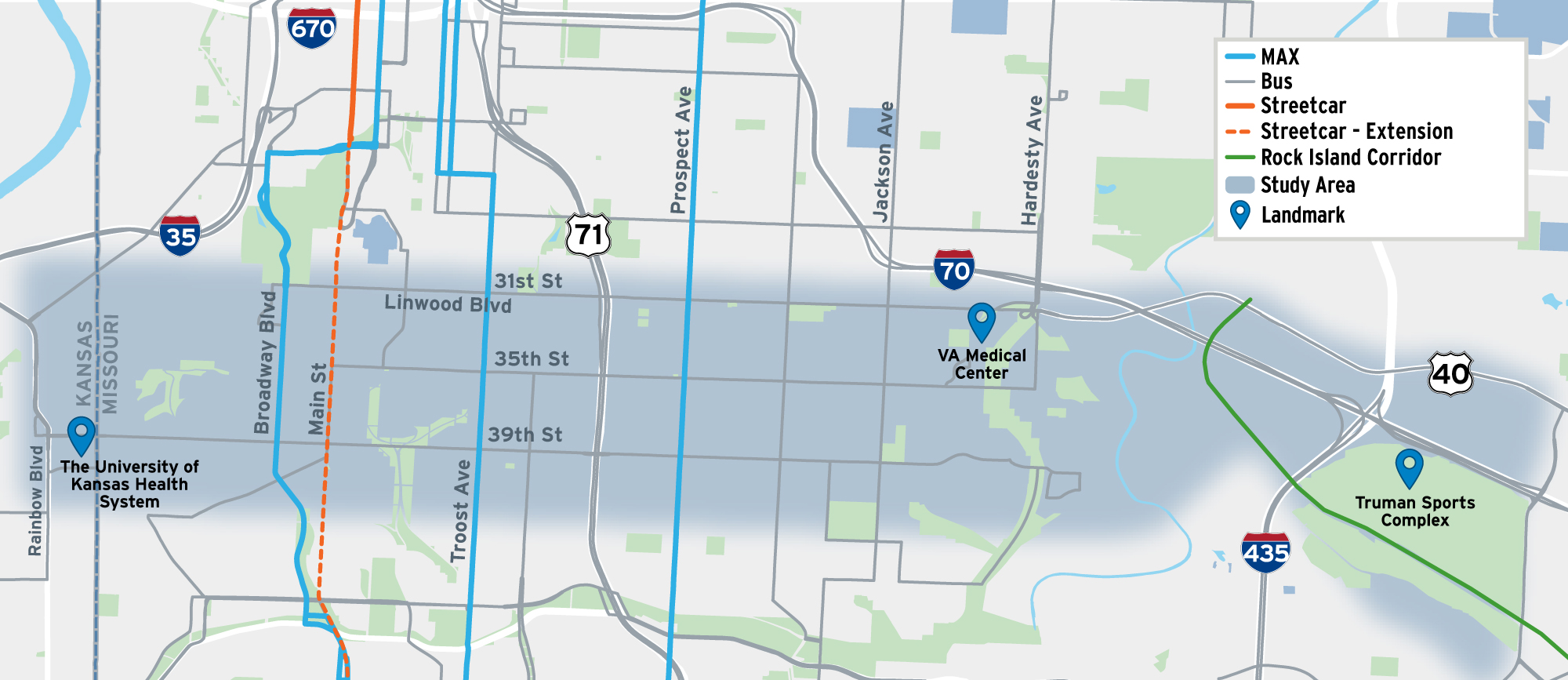
The project team is seeking community input to help determine the needs and priorities for the study in order to build a better-connected regional transit system. Feedback is critical to ensure the future of high-capacity transit in Kansas City is equitable and transformative. In addition to public and community meetings, the project team will host a series of one-on-one interviews, advisory committee meetings, and presentations throughout the study in order to keep the public connected.
“Community input is critical to fill existing east-west transit gaps in our region,” said Robbie Makinen, KCATA president and CEO. “We want to understand the community's needs first, and then use the feedback we receive to help guide the study.”
“With the KC Streetcar Main Street Extension under construction and the Riverfront Extension estimated to break ground in 2023, the time to plan future connections is now,” said Tom Gerend, Executive Director, KC Streetcar Authority. “The Main Street extension will serve as the spine of the region’s transit system, building connections to a multitude of Kansas City’s communities. But that work can only be done successfully by working with our communities to build a transit system that matches their needs and goals,” continued Gerend.
There are several opportunities for people to provide feedback during the East-West Study:
- Take a survey! A survey eliciting feedback about transit needs and priorities is available on the project website and open through Friday, June 17, 2022. The survey is also available in Spanish. Participants can request a paper survey be sent through postal mail by emailing .(JavaScript must be enabled to view this email address) or calling 816-346-0300.
- Attend a public meeting: A public meeting is tentatively scheduled for late summer 2022. Stay tuned at www.eastwesttransit.org for exact meeting dates.
- Attend a community workshop: Later this fall, the community will be invited to participate in a workshop to weigh in on options for corridor alignments and transit modes. Stay tuned at www.eastwesttransit.org for an exact meeting date.
- Participate online: Later this summer, the project team will launch an interactive study map pinpointing alignment and transportation mode options. The community will be able to leave comments and share ideas through this website.
To learn more about the RideKC East-West Transit study, visit the project webpage at www.eastwesttransit.org.
RideKC Shows Love to RideKC Flex Customers with New App
RideKC public outreach teams will be onboard RideKC Flex vehicles and at transit centers Monday to share information with customers about booking their trips using the new mobile app, RideKC Flex.
Flex vehicles pick you up where you are and take you where you want to go, unlike traditional bus service that only makes stops along a fixed route. All Flex trips must be booked within the boundaries of separate service zones. Customers can connect to other RideKC bus routes to travel throughout the region. Each Flex zone has a transit center or focal point where multiple bus routes come together for easy connections. All Flex services are currently zero fare.
Flex service operates at specific hours of the day and certain days of the week, depending on the zone. These five Flex zones can now be booked in the new RideKC Flex app:
99 South Kansas City Flex – serves 3-Trails Transit Center
297 Tiffany Springs Flex – serves Boardwalk Square Park & Ride
298 North Kansas City Flex - serves bus stops along Burlington/MO-9, Armour Road, and Chouteau Trafficway
299 Gladstone-Antioch Flex - serves Antioch Crossing
399 Raytown Flex - serves Blue Ridge Crossing and 3-Trails Transit Center
These Flex services are operated by the Kansas City Area Transportation Authority and funded in cooperation with the cities of Kansas City, North Kansas City, Gladstone, and Raytown.
Introducing the RideKC Flex App
The new RideKC Flex app, powered by Spare Labs, can be used for all Flex zones in Missouri. The new app allows customers to book and cancel trips, which was previously only offered by phone. Download the free RideKC Flex app in the Google Play and App Store.
KCATA Unveils Zero-Emission Buses Sponsored By Evergy
Dignitaries On-Site for Official Unveiling
(Kansas City, Mo. – April 7, 2021) The Kansas City Area Transportation Authority (KCATA) and Evergy are pleased to announce the unveiling of the first two electric buses to be used in RideKC public transit service in the Kansas City region. Evergy is sponsoring the vehicles with specially branded graphics that will be unveiled at the event. (Attendees will be required to have their temperatures taken and wear a mask.)
The event will be live streamed at 10 AM at the following links:
Facebook: https://www.facebook.com/EvergyPower/posts/10159492640585680
YouTube: https://www.youtube.com/watch?v=WMl-ft_LTh8
REMARKS:
- Congressman Emanuel Cleaver II
- Mayor Quinton Lucas, Kansas City, Mo.
- Kim Winslow, Senior Director of Energy Solutions, Evergy
- Robbie Makinen, President & CEO, KCATA
“This is just our first step into zero-emission vehicles,” said KCATA CEO Robbie Makinen. “We are committed to the region’s Climate Action Plan which calls for transitioning to an electric bus fleet. Zero fare electric buses will improve the financial and environmental health of our community.”
“Evergy is excited to partner with KCATA to bring electric buses to Kansas City. Electric buses provide emission-free transportation and can help make our electric grid more efficient with overnight charging,” said Kim Winslow, Senior Director of Energy Solutions, at Evergy.
The two 40-foot electric buses from GILLIG LLC, the leading manufacturer of heavy-duty transit buses in the United States will be put in service later this spring. In addition to a smoother, quieter ride and a reduced carbon footprint, the new GILLIG buses offer enhanced passenger comfort and safety features. These include easy-to-clean vinyl seats, USB charging ports at all seats, high definition cameras, drivers’ protection barriers, and passenger information monitors.
Bus charging will be supported by new ChargePoint charging stations installed at KCATA. The project is funded by the Federal Transit Administration (FTA) and matching funds from Kansas City’s ½-cent transportation sales tax.
One of the electric vehicles will operate on MAX lines and the other will travel along other local routes so customers throughout the community will be able to enjoy the environmentally friendly benefits and quieter ride.
The vehicles are powered by six onboard batteries, with a battery capacity of 444 kWh, providing an estimated range of 150 miles. The buses utilize energy recovered from a regenerative braking system and feature a direct-drive traction motor with peak torque of 3500 Nm (2,582 lbs.-ft.). They are equipped with state-of-the-art Cummins electrified powertrain. Because they are built on GILLIG’s low-floor bus platform, the new electric buses ensure parts and training commonality with KCATA’s existing GILLIG fleet.
“We’ve been partnering with KCATA for more than 20 years to provide safe, reliable, high-quality transportation,” said Bill Fay, GILLIG Vice President of Sales. “We are pleased to provide the first GILLIG battery-electric buses in Kansas City.”
# # #
Newly Appointed KCATA Board Members Attend March Meeting
The Board of Commissioners of the Kansas City Area Transportation Authority (KCATA) welcomed two new commissioners at the March 24, 2021 board meeting. The newly appointed commissioners, Reginald Townsend and Janee Hanzlick attended their first board meeting since being appointed.
Governor Mike Parson appointed Reginald Townsend to the KCATA Board of Commissioners in February. Townsend is the current Mayor Pro-Tem for the Raymore, Mo. City Council. He’s been a member of the Raymore City Council since 2017.
Townsend serves as a Financial Management Analyst for the Programs and Resources Department with the United States Marine Corps. He also currently serves as Cass County Liaison Committee Member for the Mid-America Regional Council (MARC). Previously, he was an Information Systems Specialist for the Farm Production and Conservation Business Center with the United States Department of Agriculture. He holds a Bachelor of Science in Business Administration from Baker University in Overland Park, Kansas.
Janee Hanzlick currently serves on the Johnson County Board of Commissioners. She is the former CEO of the Safehome domestic violence agency. Hanzlick’s passion for transit comes from her background in social work. She says public transportation is vital to help victims of domestic violence start a new life without their abuser.
Hanzlick is a member of the Overland Park Rotary Club. She was in the Leadership Overland Park, Class of 2007 and Past-President of the Johnson County Community Violence Action Council. She earned a Master of Social Work (MSW) degree from The Catholic University of America, Washington, DC and has been a Licensed Master Social Worker (LMSW) in Kansas for the past 28 years.
KCATA is governed by a 10-member Board of Commissioners, five from Missouri and five from Kansas. Commissioners are limited to two consecutive four-year terms. Responsibility for the management, control and operation of the Authority and its properties is vested in the Board. The Board exercises its responsibility by adopting all general policies of the Authority, including the adoption of annual capital and operating budgets, the establishment of the goals of the Authority, and the selection of a CEO. The Board may delegate certain duties and responsibilities to the CEO for the management and operation of the Authority.
KCATA Awarded Certificate Of Achievement For Excellence In Financial Reporting
The Kansas City Area Transportation Authority (KCATA) has been awarded the Certificate of Achievement for Excellence in Financial Reporting for its comprehensive annual financial report for the fiscal year that ended December 31, 2019. The Government Finance Officers Association of the United States and Canada (GFOA) awarded KCATA with the honor in early March. The Certificate of Achievement is the highest form of recognition in governmental accounting and financial reporting. This is the second year in a row KCATA has received the award.
“KCATA is proud to receive this recognition of our efforts to provide transparency in our budgeting process and to ensure that regulatory compliance, accurate financial reporting, and good stewardship of taxpayer funds and organizational assets is achieved,” said KCATA President and CEO Robbie Makinen. “This certificate of achievement shows the great strides KCATA has made in our social responsibly and accountability to our customers, our partner agencies, governmental bodies and our board of commissioners."
The GFOA established the Certificate of Achievement for Excellence in Financial Reporting Program (Certificate Program) in 1945 to encourage and assist state and local governments to go beyond the minimum requirements of generally accepted accounting principles to prepare comprehensive annual financial reports that evidence the spirit of transparency and full disclosure and then to recognize individual governments that succeed in achieving that goal.
The award-winning financial report can be found on KCATA.org.
KCATA Board of Commissioner Elects New Officers; Adds Two New Appointees
(Kansas City, Mo. – Jan. 27, 2021) The Board of Commissioners of the Kansas City Area Transportation Authority (KCATA) elected new officers at the Jan. 27, 2021, board meeting. The current Board Chair, Commissioner David Bower of Jackson County, Mo., will continue as Chair and Commissioner Melissa Bynum of Unified Government of Wyandotte County-Kansas City, Kan., was re-elected Vice Chair. Commissioner Louie Wright of Clay County, Mo., was elected Treasurer and Commissioner Joe Peterson of the Unified Government was elected Secretary. The KCATA Board of Commissioners is made up of five people from Missouri and five from Kansas. Officers are nominated at the end of the year and officially elected in January of each year.
KCATA also welcomed two new commissioners to the board.
Tamika McClaine, small business owner, blogger and speaker, will represent Unified Government of Wyandotte County-Kansas City, Kan. McClaine has been a transit advocate for public school children for nearly a decade. She started in public service on her local school’s PTA Board. While working on the board of the Kansas City, Kan. PTA council, she pushed for parent involvement and safer routes to schools. She also served on the board of Drive Wisely - Wyandotte and was integral in helping get infrastructure improvements near local schools.
John Stamm, Chief of Staff to Mayor Quinton Lucas, joins as the representative to Kansas City, Mo. Born and raised in KC, he graduated from UMKC with degrees in Philosophy and Business. While at UMKC, he founded a nonprofit tutoring company, helping hundreds of low-income students improve their ACT and SAT scores. After several positions in the nonprofit sector in St. Louis and New York City, he returned to his hometown to manage Quinton Lucas’ campaign for Mayor. In his current role, he has had the privilege to help lead Kansas City’s response to COVID-19, guide the office of the Mayor in responding to several crises, and provide direction on the long-term policy goals of the administration.
In 2021, KCATA Board of Commissioners meetings will be held bi-monthly. Until further notice, all regular meetings, committee meetings and special meetings of the Board will be held via teleconference. For more information about the Board, visit our webpage for Board of Commissioners.
# # #
KCATA Wins KDOT Innovation and Technology Grant to Improve Public Transit Integration
Micro Transit to be available in the Transit app starting mid-2021
(Kansas City, Mo. – Dec. 10, 2020) – The Kansas City Area Transportation Authority (KCATA) has been awarded a $59,000 innovation and technology grant from the Kansas Department of Transportation to integrate micro transit into Transit, RideKC’s official app for bi-state regional transit.
Based on nearly two years of micro transit operations, there is evidence that customers are transferring between micro transit and fixed-route services. Currently, two micro transit zones on the Kansas side – one in Johnson County and one in Wyandotte County – are not yet integrated in the Transit app. This grant from KDOT will enable riders to use the app to plan multimodal trips that combine micro transit with fixed-route service, beginning in mid-2021. Transit is RideKC’s official app to plan trips and track the location of buses throughout the Kansas City region.
“Micro transit ridership is growing rapidly on the Kansas side of the metro with financial commitments from local governments,” said Robbie Makinen, KCATA president and CEO. “Currently users in Johnson and Wyandotte counties must toggle between two separate smartphone apps to integrate their micro transit trips with fixed-route transit service. This integration will improve access to jobs, health care, education and equitable opportunities.”
“This micro transit integration is going to have a macro impact,” said David Block-Schachter, chief business officer at Transit. “By adding micro transit to its official app with fixed-route, RideKC will help its customers make the most out of both services. We’re excited to kick off work with TransLoc and bring RideKC riders an easy way to integrate micro transit into their commutes.”
KDOT funded the 2020 expansion of micro transit in Johnson County. Both Wyandotte and Johnson counties are looking at possible expansion beyond the current micro transit zones.
The Greater Kansas City Chamber of Commerce has identified micro transit as a way to meet the needs of their members and increase access to jobs.
For more information on micro transit service, go to RideKC.org.
###
About Transit: Transit solves the urban commute in more than 200 cities worldwide. Users can easily navigate public transit with accurate real-time predictions, simple trip planning, step-by-step navigation and quick, easy payments. The app also integrates additional transport modes — bikesharing, scooters, carsharing and ridehail — so users can mix-and-match their options with public transit to determine the best way to get from A to B. The company is based in Montréal, QC. Learn more by visiting [url=http://www.transitapp.com]http://www.transitapp.com[/url].
AboutTransLoc: TransLoc is a subsidiary of Ford Mobility. We are part of a broad suite of mobility solutions intended to enhance both public and private transit agencies. Together, we are working to solve the world’s mobility challenges and usher in the future of modern transportation in every part of the globe.
RideKC Reduces Service Due to Staffing Shortages Related to COVID-19
(Kansas City, Mo., December 7, 2020) – The Kansas City Area Transportation announces a temporary reduction in RideKC transit service starting Monday, Dec. 14, due to staffing shortages among the operator workforce and increasing community spread of COVID-19. RideKC transit should be used for essential trips only, effective Nov. 18.
The following routes will be temporarily discontinued effective Dec. 14:
- 9 9th Street
- 15 Truman Road
- 55 Universities-Crossroads
- 233 Vivion-Antioch
These changes are in addition to previous changes that were implemented Nov. 23, 2020. Other routes will maintain current schedules at this time. However, if regional impacts of COVID-19 or staffing levels get worse, additional changes may be necessary. Customers are encouraged to sign up for RideKC Notify to receive a text, email or voice message about changes affecting specific routes. It’s easy to sign up and select notification preferences.
These changes are designed to retain access to jobs, education, healthcare and equitable access for low-income residents who need public transportation most.
“RideKC will continue to provide essential service to riders at zero fare,” said Robbie Makinen, KCATA president and CEO. “If customers must make essential trips, they can have confidence that RideKC is continuing all of the safety protocols that have been in place consistently throughout the pandemic, such as a mask requirement, rear door boarding and limiting the number of seats available.”
Essential Trips Only
Consistent with the Safer At Home orders and recommendations issued by area counties and municipalities, KCATA recommends transit riders only make essential trips, such as:
- Rides for groceries.
- Trips for physical and mental health needs such as appointments and to pick up prescriptions.
- Trips for essential jobs including hospital, medical, grocery, food service, and essential production.
RideKC COVID guidelines
See more about the current status of transit at RideKC.org/bulletins/covid
- Face coverings are required for riders and bus operators.
- Fares are suspended on all bus and paratransit services other than 199 Micro Transit and 499 Micro Transit.
- Social distancing is required on buses.
- Riders should board and exit buses at the back door unless they have a disability that requires the ramp or kneeling feature, available at the front of the bus.
For further information, contact the Regional Call Center at 816-221-0660, weekdays from 6 a.m. to 6 p.m.
RideKC Reduces Bus Service Due to COVID-19 Impact
(Kansas City, Mo. – Nov. 17, 2020) – The Kansas City Area Transportation Authority (KCATA) will temporarily roll back some RideKC transit service starting Monday, Nov. 23. This is due to the increasing community spread of COVID-19, which is resulting in higher than normal absenteeism among KCATA’s operator workforce.
Consistent with the Safer At Home orders and recommendations issued by area counties and municipalities, KCATA, in partnership with the city of Kansas City, Mo., recommends transit riders only make essential trips going forward, such as:
- rides for groceries
- trips for physical and mental health needs such as appointments and to pick up prescriptions
- and trips for essential jobs including hospital/medical, grocery/food service, and essential production.
“RideKC will continue to provide essential service to riders at zero fare,” said Robbie Makinen, KCATA president and CEO. “If customers must make essential trips, they can have confidence that RideKC is continuing all of the safety protocols that have been in place consistently throughout the pandemic, such as a mask requirement, rear door boarding and limiting the number of seats available.”
Transit operators are on the front line seven days a week and we’re proud of the work they are doing during this challenging time. Contact tracing indicates employee exposure is mostly due to activities and risks from outside of the workplace.
In general, most RideKC core routes operating every 15 minutes will continue at that level of service. Low frequency routes will be temporarily canceled to allow the remaining operators to focus on the core network, where the need is greatest.
For the latest schedule updates and RideKC news, please check our website and follow us on social media
# # #.
KCATA Holds Public Online Meetings To Share Transit Redesign Developed By Customers, Stakeholders
KCATA Holds Public Online Meetings To Share Transit Redesign Developed By Customers, Stakeholders
(Kansas City, Mo. – Nov. 9, 2020) – The Kansas City Area Transportation Authority will hold virtual public meetings to present the RideKC Next transit plan developed by customers and stakeholders over the last year and a half. Customers are encouraged to attend the online meetings to provide valuable input about this next phase of the RideKC Next plan in Kansas City, Mo.
“The RideKC Next plan reflects the needs and desires of the community,” said Robbie Makinen, KCATA president and CEO. “We listened and are responding with a plan that provides better access to jobs, health care, education and social equity. It is a plan that addresses community needs for the next 20 years, not the last 20. And, we are providing it zero-fare for riders.”
The RideKC Next plan provides the same amount of service, reallocated to expand access to jobs, health care, education and social equity. The goal of the revised plan is to provide a simpler, easier and more efficient network that connects more people to opportunities. The proposed restructuring includes establishing a frequent grid in the core of the transit network, while also providing flexible service that covers larger areas and provides access to the system.
KCATA has been zero fare since March 2020 to better meet the needs of customers who rely on transit to connect to jobs, essential services, and other opportunities. A single parent with two children saves $2,100 a year, which will be invested elsewhere in the local economy.
Upcoming Meetings
There are six RideKC Next informational Zoom sessions scheduled over the next month. Attendees may drop in and out during a session to learn about planned changes and provide input. To join the meeting, click on the provided link. When prompted, select “Run” to launch the meeting. Please wait for RideKC to admit you. A Zoom account is not necessary to attend a meeting. The meetings can also be attended by calling in to an access number. Those call-in details are available at ridekcnext.org.
- Thursday, Nov. 12, 11 a.m. - 1 p.m. Join this meeting
- Tuesday, Nov. 17, 7-9 a.m. Join this meeting
- Thursday, Nov. 19, 4-6 p.m. Join this meeting
- Monday, Nov. 23, 12-2 p.m. Join this meeting
- Saturday, Dec. 5, 11 a.m. - 1 p.m. Join this meeting
- Wednesday, Dec. 9, 5-7 p.m. Join this meeting
What’s proposed in the RideKC Next plan?
A frequent grid to connect more people to opportunities.
- All frequent routes would provide service every 15 minutes on weekdays and Saturdays, and every 30 minutes on Sundays.
- Routes on the frequent grid will operate from 5 a.m. to midnight, seven days per week. Service will be frequent from 6 a.m. to 8 p.m., Monday through Saturday.
- All MAX service would offer 15-minute frequency to 75th St., with less frequent service south of 75th St.
- East-West service would improve to every 15 minutes on key routes (12 12th St., 39 39th St., 47 47th St. to KU Med Center.
- More weekend service would be provided. Saturdays would offer 85% of weekday levels and Sundays would offer 65% of weekday levels.
A simpler, easier and more efficient network.
- Nearly all fixed routes will run from 5 a.m. to 8 p.m. seven days a week.
- The proposed plan would streamline duplicate coverage connecting neighborhoods to downtown.
The proposal represents input from extensive public outreach obtained in early 2020, as well as analysis of travel patterns and needs during the 2020 pandemic. In addition to the meetings being held now, RideKC will offer personalized travel training in the spring of 2021 leading up to planned implementation in July 2021.
Customers may ask questions or submit a comment by calling 816-346-0300 or email .(JavaScript must be enabled to view this email address).
To review plan materials in advance of the public meetings go to ridekc.org. Maps and hours of service by route will be available online by Nov. 12.
RideKC Transit App Provides Transit Directions To Polling Places on Election Day, Nov. 3, 2020
(Kansas City, Mo. – Nov. 2, 2020) – The Kansas City Area Transportation Authority is reminding voters that they can easily take RideKC transit to their polling place for free. All polling places for the Nov. 3 election are available on RideKC’s official app, Transit.
Approximately 52% of regional polling places are located within ½-mile of public transit. To get started, simply download the Transit app to plan a trip to your polling place. Blue checkmarks indicate a polling place. Viewers may need to zoom out to see polling places.
Don't know which polling place is yours? Visit [url=https://ridekc.org/blog/election-day]https://ridekc.org/blog/election-day[/url] for links to confirm your voter registration and polling place.
KCATA will also provide free shuttle service on RideKC buses from the East Village Transit Center at 12th & Charlotte in downtown Kansas City to Arrowhead Stadium on Election Day. The shuttle will run between 5 a.m. and 9 p.m. approximately every 30 minutes on Tuesday, Nov. 3, 2020. The stadium will be available for registered Kansas City, Mo., voters who live in Jackson County.
RideKC fares have been suspended due to COVID.
In addition, RideKC Bike is offering two free rides to help people vote. Use code BIKETHEVOTE20 on the RideKC Bike app Nov. 3.
For complete route and schedule details going to the polls and advance voting sites, go to ridekc.org.
# # #
KCATA Partners with Alphapointe to Roll Out New Transit App for Visually Impaired
The Kansas City Area Transportation Authority (KCATA), in partnership with Alphapointe and Sensible Innovation, has developed a wayfinding app to help blind and visually impaired transit customers use transit more safely and accurately. It is the first application of its kind to be applied to an entire transit corridor in the United States.
The RideKC Navigator mobile app is a custom platform to help individuals with vision impairment or blindness navigate select transit stops. Anyone can download the free RideKC Navigator app on their mobile device (iOS and Android) to receive location-specific audio instructions to help navigate 51 bus stops, East Village Transit Center, 75th Street Transit Center and 31 intersections in Kansas City, MO.
The project, which was developed as part of KCATA’s Prospect MAX Bus Rapid Transit (BRT) 10-mile corridor project runs from the 75th and Prospect Transit Center at Alphapointe, north on Prospect to 12th Street, and west along 12th Street into downtown Kansas City.
“Our partnership with Alphapointe was critical to the testing and deployment of RideKC Navigator,” said Robbie Makinen, KCATA president and CEO. “Our visually impaired experts at Alphapointe navigate the real world on a daily basis. Their help in orientation and mobility instructions, testing and tutorials was invaluable.”
Alphapointe is the largest employer of blind and visually impaired people in Missouri, and one of the largest in the nation, according to Reinhard Mabry, president and CEO of Alphapointe.
“This app will open up the community to people who are blind,” Mabry said. “It will prepare people who have visual impairment to navigate spaces and areas of the community that they may not have been comfortable with previously because they didn’t know enough about their surroundings.”
“To have this app in Kansas City is an incredible, innovative experience,” said Jim Fettgather, who is visually impaired and assisted with development and testing.
Key points along the Prospect MAX route include East Village Transit Center at 12th & Charlotte with connections to multiple bus routes, Independence plaza, ReDiscover Crisis Center, East Patrol Division Station, Linwood Shopping Center, Research Medical Center and 75th Street Transit Center at Alphapointe.
KCATA Partners with Kansas City Chiefs and Patrick Mahomes’ 15 and the Mahomies Foundation to Provide Free Shuttle to Arrowhead on Election Day, Nov. 3
(Kansas City, Mo. – Oct. 27, 2020) – The Kansas City Area Transportation Authority (KCATA) will provide free shuttle service on RideKC buses from the East Village Transit Center at 12th & Charlotte in downtown Kansas City to Arrowhead Stadium on Election Day. The shuttle will run between 5 a.m. and 9 p.m. approximately every 30 minutes on Tuesday, Nov. 3, 2020.
The stadium will be available for registered Kansas City, Mo., voters who live in Jackson County. The service is being provided in partnership with the Kansas City Election Board, and with donations from the Kansas City Chiefs and Patrick Mahomes’ 15 and the Mahomies Foundation.
RideKC also serves dozens of Election Day polling sites and advance polling locations in Kansas City, Johnson County and Wyandotte County with regular transit service. Fares have been suspended due to COVID, although RideKC traditionally offers free rides on Election Day.
Find links to your local election board here: ridekc.org/blog/election-day.
Hours and dates may vary by polling place. Check the links for more details. Advance voting locations are listed below if they are served by RideKC transit. Additional in-person voting options may be available.
Advance Voting Options
Find links to your local election board here: ridekc.org/blog/election-day.
Hours and dates may vary by polling place. Check the links for more details. Advance voting locations are listed below if they are served by RideKC transit. Additional in-person voting options may be available.
Kansas City Election Board (Jackson County only): See up-to-date hours and locations.
- Union Station, Innovation Room, 30 W Pershing Rd.: Take Streetcar, 23, 27, 47, 51, 535, 570.
- Gregory Hills Church of God, 7020 James A. Reed Rd.: Take 28, 29, 399.
- United Believers Community Church, 5600 E 112th Ter.: Take 99.
- The Whole Person, 3710 Main St.: Take Main MAX, 35, 39.
- Bruce R. Watkins Cultural Center, 3700 Blue Parkway: Take 18, 21, 47.
Johnson County Advance Voting: See up-to-date hours and locations.
Take 499 Micro Transit to get to these locations.
- Arts and Heritage Center, 8788 Metcalf Avenue
- Johnson County Election Office, 2101 East Kansas City Road
- Johnson County Northeast Offices, 6000 Lamar Avenue
- Johnson County Sunset Office Building, 11811 South Sunset Drive
- Oak Park Mall, 11327 W. 95th St.
- Olathe Indian Creek Library, 16100 W. 135th St.
Wyandotte County Advance Voting: See up-to-date hours and locations.
Election Office: 850 State Avenue: Take routes 101, 104, 106, 402.
- Joe Amayo/Argentine Community Center: Take 104.
- Eisenhower Rec Center: 2901 N 72nd St.: Take 113.
RideKC on Election Day, Nov. 3
Use our guide to confirm that you are registered to vote and find your polling place.
Then, if you need to find out what route to take to your polling place, all polling places in Jackson County, Johnson County and Wyandotte County will be included in Transit, RideKC's official app, by Oct. 29.
In addition, RideKC Bike is offering two free rides to help people vote. Use code BIKETHEVOTE20 on the RideKC Bike app Nov. 3.

# # #
KCATA Receives $600K Innovation Grant for Precision Guidance Sensors
(Kansas City, Mo. – August 31, 2020) – The Kansas City Area Transportation Authority (KCATA) today announced that it will receive $600,000 in funding through the U.S. Department of Transportation’s Federal Transit Administration (FTA) Accelerating Innovative Mobility (AIM) initiative to support mobility and innovation in the transit industry.
KCATA will use the funds to test an advanced driver assistance system that uses precision guidance sensors to dock at stations and provide level boarding across the RideKC MAX bus rapid transit system. The project will improve accessibility and reduce dwell time, providing a better customer experience.
“I want to thank the U.S. Department of Transportation and our entire congressional delegation for their continued support of our MAX Bus Rapid Transit system,” said Robbie Makinen, president and CEO of KCATA. “This AIM initiative will demonstrate further innovative technologies that we are integrating into the MAX system. The project will enhance the customer experience for everyone while going beyond ADA-compliance.”
"As we face this public health emergency, investments in innovation are critical for transit agencies to better meet rider expectations and adapt to changes in our transportation system," said FTA Deputy Administrator K. Jane Williams. "We are pleased to collaborate with these grant recipients to develop new service methods to improve safety, increase access, develop more efficient operations, and enhance the transit experience for all."
“Robotic Research is honored to partner with Kansas City Area Transportation Authority (KCATA) to provide an innovative and cost-effective solution for ADA-compliant level boarding on KCATA’s Prospect MAX BRT,” said Alberto Lacaze, President of Robotic Research. “Our advanced driver assistance system (ADAS) technology will assist BRT drivers to precisely dock buses and maintain ADA-compliant gaps at all stops, ensuring access for all customers, including persons with disabilities.”
FTA today announced 25 projects in 24 states and Guam will receive a share of $14 million. Nine of the projects directly address innovations to help alleviate issues related to COVID-19-, including contactless payment, social distancing, innovative scheduling, real-time information to reduce crowding and contact tracing.
###
RideKC Partners with Swiftly to Launch Improved Real-Time Information
(Kansas City, Mo. – Aug. 17, 2020) The Kansas City Area Transportation Authority (KCATA) has partnered with Swiftly, Inc., a San Francisco-based big data platform for public transit and mobility services, to bring improved real-time transit arrival and vehicle crowding predictions to RideKC. These improvements were tested internally at KCATA in 2020 and are now fully implemented.
As part of this project, Swiftly is leveraging existing GPS data from onboard broadband routers and the agency’s dispatch system, Trapeze’s TransitMaster. Swiftly leverages this vehicle position information to more accurately predict when the next bus will arrive, rather than relying solely on the existing dispatch system. Customers and RideKC staff can now access more accurate bus arrival and position information right from their phone, via the free Transit app. This will also improve accuracy of real-time information available at digital displays, including those along Prospect MAX and at 3-Trails, East Village and 75th & Prospect transit centers.
Swiftly gives customers more frequent location updates every few seconds, instead of every 30 seconds. When a bus is traveling at 30 miles per hour down a major thoroughfare, that can be the difference between missing the bus and the bus being a block away.
Transit app is using the same feed to provide real-time vehicle crowding information using existing Automated Passenger Counters (APCs) onboard select vehicles. Eventually, the entire RideKC fleet will be capable of providing this information, which has been widely adopted during the COVID-19 pandemic.
“We are pleased to roll out another innovative partnership that will result in a better customer experience,” said Robbie Makinen, KCATA president and CEO. “Swiftly is like a protein booster to a smoothie…it gives riders information that is more accurate and reliable than it is today.”
Swiftly’s CEO Jonny Simkin shares RideKC’s enthusiasm. “We’re proud to work with RideKC to make their transit system more efficient, reliable and seamless. This partnership will empower passengers with highly accurate real-time information and will enable the RideKC staff to leverage big data for enhanced decision-making.”
Mobile App
RideKC’s official app is Transit. The free Transit app offers many features to help riders get around the region, including quick access to accurate real-time transit information and live maps with vehicle locations and crowding information. In addition, Transit app also contains a trip planner to help users compare the travel time and price of a variety of transportation options, including walking, biking, transit, rideshare and more. Riders can download the Transit app from the Apple® App Store for iOS devices, Google Play™ for Android devices, or by visiting https://transit.app/.
Performance Monitoring and Reporting
In addition to real-time arrival predictions, RideKC administrative staff has access to Swiftly’s robust dashboard for advanced and intuitive reporting and performance analysis. Staff can view real-time bus location for the entire fleet, view historical location information, compare on-time performance of routes, evaluate run times, and analyze the bus speed for all routes. This information is invaluable for transit planners when considering passenger requests and service modifications.
# # #
RideKC Improves Service August 2; New East Village Transit Center Opens
(Kansas City, Mo. – July 27, 2020) The Kansas City Area Transportation Authority (KCATA) announces good news for RideKC customers beginning Sunday, Aug. 2, 2020. First, the newly built East Village Transit Center at 12th & Charlotte will open for bus service. Second, starting in August, several routes will restore weekday service, or add trips where crowding has been occurring.
“These improvements will allow workers and other residents to get to essential services,” said Robbie Makinen, KCATA president & CEO. “RideKC has taken several steps to ensure the safety of our customers and operators, including suspending fares, and requiring masks, social distancing and rear boarding. Together, we can all keep public transportation safe.”
East Village Transit Center Opens
The East Village Transit Center will open as the main downtown transit facility, replacing the 10th & Main location that has become too small for RideKC’s needs. The facility at 10th & Main will close to transit Aug. 2. East Village provides frequent east-west connections to the core of downtown and serves as the downtown anchor for the new 10-mile Prospect MAX line. The transit center will be accessible for people with disabilities and will include one-step level boarding, bike racks, RideKC Bike rentals, and show real-time arrival information. Future improvements include free public WiFi. An indoor waiting area is expected to open when COVID-19 is no longer a local threat. The Customer Service Lobby at 18th & Forest will relocate there at that time. Nearly 20 MAX, local and express routes will serve the East Village Transit Center.
RideKC Bus Service Restored, Improved
In line with RideKC’s Service Restoration Plan, regular weekday service will be restored on select routes effective Aug. 2, 2020. This expanded service is based on a detailed review of current ridership patterns, the need to maintain social distancing, and restoring access to essential jobs and services in areas with no other coverage.
Several routes will have regular weekday service restored. Several additional routes will maintain existing service, with Saturday schedules operating on weekdays, but with added trips in the early morning. Some routes may have time changes. Many routes will now travel to East Village Transit Center as the 10th & Main Transit Center closes.
Routes operated by the Unified Government, Johnson County, and the City of Independence are not impacted.
Detailed maps and timetables are available at ridekc.org. For more information, call the Regional Call Center at 816-221-0660 from 6 a.m. to 7 p.m. on weekdays
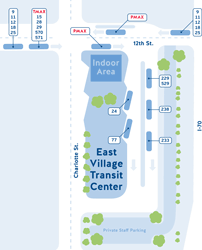
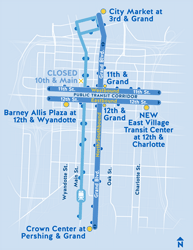
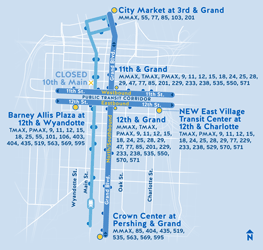
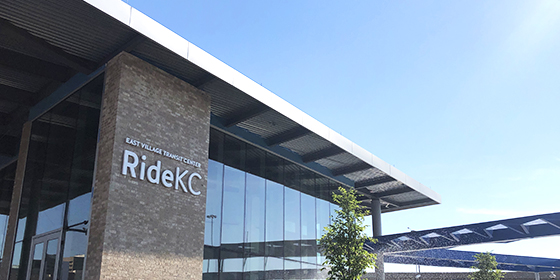
RideKC Announces Transit as Its New Official App
Riders have a go-to app for real-time information, trip planning, and payments
(Kansas City, Mo. | May 6, 2020) RideKC announces Transit as Kansas City’s official mobility app. Riders can use the app to plan their trip, track their ride in real time and make multimodal connections to RideKC bikeshare, scooters, Uber and Lyft. Plus, on trips that include fares, RideKC riders will soon be able to use Transit to pay for their journey. Transit replaces the RideKC app, which will no longer be supported after May 6, 2020.
Thousands of Kansas City riders already use Transit, the leading transport app in North America with millions of active users in more than 200 cities worldwide. During and after the coronavirus outbreak, Transit provides up-to-date transit information to everyone who relies on public transit for critical trips.
Upon launching Transit, RideKC users see nearby transit options and departure times in big text and bright colors. Users can navigate the region, aided by accurate real-time tracking, trip planning, and step-by-step navigation with Transit’s GO feature. They can subscribe to service alerts for their favorite transit lines and receive notifications with the latest updates. Users can also see the availability of RideKC bikes and scooters in real time on the home screen, or book and pay for an Uber or Lyft ride directly in the app.
Download the app


RideKC has currently suspended fare collection due to the COVID-19 outbreak. As fare collection resumes on a limited number of routes, riders will be able to purchase fares in the app, providing a safe and easy solution to minimize physical contact between drivers, riders, and shared surfaces. As a result of its partnership with Transit, RideKC will also receive anonymous, aggregated data and customizations to better serve the public, such as the ability to send important information directly to riders on Transit’s home screen.
RideKC joins dozens of other transit agencies across North America that have partnered with Transit, including Boston’s MBTA, St. Louis Metro, Baltimore’s MDOT MTA, Tampa Bay’s PSTA and Silicon Valley’s VTA.
"The new Transit app will take RideKC's customer experience to a new level," said Robbie Makinen, President and CEO of KCATA. "It's a one-stop-shop connection to regional transit, giving customers more choices and control over their mobility options."
“We want to make it easy for people to hop aboard RideKC. Partnering with a single app that prioritizes transit makes it clear to riders where they can go for information,” said David Block-Schachter, Chief Business Officer at Transit. “During and after the coronavirus response, people depending on public transit need to know where they can turn for accurate information and latest service updates. We’re excited to work with RideKC to make public transit more reliable, and see more people using Transit as part of their daily routine.”
Transit is available to download for iPhone and Android at www.transitapp.com.
###
Sound the Horn for Transit Workers: April 16
RideKC is joining transit agencies across the nation to “sound the horn” for transit workers and other front line workers who are keeping communities going during the COVID-19 pandemic.
At 2 p.m. on Thursday, April 16 RideKC bus operators will honk their horns twice, in recognition of #HeroesMovingHeroes on the front lines of this crisis. Transportation workers continue to provide critical service for healthcare workers, first responders, childcare workers, grocery store employees and other heroes who are performing critically essential work during the Covid-19 pandemic.
RideKC is joining transit agencies from coast to coast in sounding their horns, including the Metropolitan Transportation Authority (MTA) in New York City, Amtrak and many others.
We encourage everyone to sound off with their support for front line staff and all who keep going to work while the rest of the world stops. At 2:00 p.m., you can also make some noise in person or online, with a honk, whistle, or a virtual shout out.
Share a message, photo or short video of your tribute. Use the hashtags #soundthehorn or #heroesmovingheroes and tag RideKC: @RideKCTransit on Twitter or @RideKC on Instagram and Facebook.
RideKC Reduces Bus Service in KCMO Due to Stay-at-Home Order
UPDATE 4/10: Johnson County announces a reduction in transit service levels to help reduce the spread of COVID-19 while maintaining access to essential businesses and services for riders.
In response to the Stay-At-Home order issued by area counties and municipalities, Kansas City Area Transportation Authority (KCATA) in partnership with the City of Kansas City, Mo., will reduce transit service starting Sunday, April 12, 2020. Bus routes originating in Kansas City, Mo., will run on modified service with most routes using a Saturday schedule that will end at 9 p.m. Many routes that don’t run on Saturdays will now be added to a Saturday schedule to accommodate our regional partners’ transit needs. All Sunday routes will run as normal but will now end at 9 p.m.
Other RideKC regional services will operate on the schedules below:
- Unified Government Transit in Kansas City, Kan., service will continue on a regular weekday schedule.
- Johnson County routes will reduce transit service levels, effective April 13. 510 K-10 Connector between University of Kansas – Lawrence and Johnson County Community College will continue using a break schedule.
- Independence, Mo., transit will also operate on its regular weekday schedule.
- The 529, 535, 550, 570 and 571 will operate a limited express route.
- RideKC Flex in Raytown and Gladstone will continue running.
Our average daily ridership has taken a sharp decrease since the Stay-At-Home order was issued. We are experiencing higher than normal absenteeism – more than 120 operators daily. Even with a decline in ridership and higher absenteeism we hope to keep all of our full-time Bus Operators employed during this crisis. Unfortunately, we had to lay-off about 66 part-time operators.
With the region under stay at home orders, KCATA continues to deliver a vital public service to health care workers, pharmacy employees, grocery store employees and others employed in essential jobs. Transit operators are on the front line seven days a week and we’re proud of the work they are doing during this challenging time.
For the latest schedule updates and RideKC news, please check our website and follow us on social media and at RideKC.org.
KCATA April 6 COVID-19 Update
KCATA continues to deliver a vital public service to health care workers, pharmacy and grocery store employees, and others working or traveling to essential destinations. Transit operators are on the front line seven days a week and they deserve special recognition for their commitment and service during this challenging time. With the region under stay-at-home orders, residents are encouraged to use public transit for essential trips only.
Absenteeism has continued to be higher than normal, averaging more than 120 bus operators absent daily. As of April 6, eighty employee absences are directly related to COVID-19, with 71 self-quarantined, eight with childcare issues. On Monday, April 6, 2020, we were notified that one of our employees tested positive.
“The health and safety of our KCATA employees is paramount,” said Robbie Makinen, President & Chief Executive Officer, KCATA. “We will continue to take proactive measures to protect our employees and community as we weather the impacts of COVID-19.”
We encourage everyone to exercise caution and take all appropriate health and safety measures to help prevent the spread of COVID-19.
RideKC Regional Transit Services Response to COVID-19
(Kansas City, Mo. – March 19, 2020) – In an effort to protect transit operators, customers and the general public, Kansas City Area Transportation Authority (KCATA) announces that all RideKC regional transit services have taken a variety of proactive measures in response to the spread of the novel coronavirus.
“As our community faces this crisis, we can’t lose sight of the impact it is having on so many individuals,” said KCATA President & CEO Robbie Makinen. “With every closure that is announced, there are hard-working people on the other end feeling the impact, not to mention those dependent on access to medical care and essential jobs. We’re not going to run away from the people who need us most. We’re going to run toward them. RideKC encourages our customers to practice social distancing and only travel as necessary. Our partners at the KC Streetcar, RideKC Bike & Scooter and our transit partners on both sides of the state line are teaming up to make our broad-based communities safer.”
RideKC Transit Suspends Fares Temporarily
RideKC regional transit partners will temporarily suspend fares on public transit effective immediately. Suspending fares will improve safety by reducing the handling of cash and touching surfaces by so many people. Participating transit partners are KCATA, Unified Government Transit, Johnson County, Kan., the cities of Kansas City, Mo., Independence, Lee’s Summit, Blue Springs, North Kansas City, Riverside, Gladstone, Raytown, Liberty, Unity Village and Grandview.
“I care first and foremost about the health and safety of all Kansas Citians and urge all residents to practice social distancing and to stay home unless absolutely necessary,” said Kansas City, Mo., Mayor Quinton Lucas. “I also understand that there are many in our community—those who work in essential jobs, or have to make necessary trips to purchase groceries, supplies, or obtain medical treatment—who rely on public transportation to get them there. By eliminating bus fares, coupled with several other health and safety measures KCATA has already implemented, we are better protecting our bus drivers and riders alike. This is a positive example of our regional collaboration to fight for equity in the wake of this public health pandemic.”
“On behalf of Wyandotte County, we appreciate the efforts of RideKC to accommodate the needs of our residents, as all of us must continually adapt to an ever developing situation,” said David Alvey, Mayor/CEO of the Unified Government of Wyandotte County/Kansas City, Kan.
“We are glad to cooperate with KCATA and our other metro partners in this effort,” said Ed Eilert, chairman, Board of County Commissioners, Johnson County, Kan.
“It’s times like this that we see how strong and how caring our region is,” said Independence Mayor Eileen Weir. “We see medical professionals on the front line, but let’s not forget our transit operators who are also on the front line continuing to serve our communities every day. I think we owe them a big thank you at this very uncertain time in our nation.”
RideKC Taking Measures to Protect Customers on Board
RideKC fleets are sanitized nightly with either a misting sanitizer using aqueous ozone or wiping down surfaces with a sanitizer. Hand sanitizer is available for passengers. Educational information encouraging social distancing, frequent hand washing, avoiding face touching and covering sneezes and coughs have been shared for weeks across all of our media channels. Customers are encouraged to let us know if they see an unhygienic surface on the vehicles or at a shelter or station by telling the operator, another transit employee or calling customer service at 816-221-0660.
Misting sanitizers used by RideKC: The misters use stabilized aqueous ozone. The compound is H203. H203 is food-grade safe and there is no chemical harm. Stabilized aqueous ozone is a safe, sustainable alternative to traditional chemical cleaners and sanitizers. It has been used to sanitize drinking water, produce and surgical instruments.
Please follow our social media channels and monitor our website at RideKC.org for the latest information.
RideKC Streetcar Reduces Hours Temporarily
In response to COVID-19, the KC Streetcar will temporarily operate with reduced hours, ending service at 8 p.m. nightly. Starting on Friday, March 20, the KC Streetcar will operate from 6 a.m. to 8 p.m., Mondays through Fridays, and 7 a.m. - 8 p.m. on Saturdays and Sundays. The KC Streetcar will continue to operate three streetcars, seven days a week providing important access to grocery stores, critical employment centers, medical facilities, and pharmacy services.
This shift aligns with recent changes in downtown activity levels and allows the KC Streetcar team additional time to clean all streetcar vehicles and stops as well as providing staff important time with their families.
“This schedule modification responds to, and supports, Mayor Lucas’ Emergency Declaration related to the closure of restaurants, bars and downtown activity centers, and aligns our service-levels appropriately. We are encouraging all streetcar riders to limit trips to those that are necessary and respect the social distancing guidelines put forward by the CDC,” said Tom Gerend, executive director, KC Streetcar Authority.
As part of the daily maintenance routine, all KC Streetcars receive a mid-day cleaning and a thorough cleaning at the end of every day. The cleaning products are effective against numerous bacteria and viruses, including the Human Coronavirus and Influenza Type A Virus. Other proactive measures include installing hand sanitizer dispensers on every KC Streetcar vehicle, automatically opening all streetcar doors for riders, and operators being equipped with gloves, hand sanitizer, Clorox wipes and Lysol, which is sprayed onboard every time a streetcar arrives at the Union Station streetcar stop.
For up-to-date information about the KC Streetcar's response to the Coronavirus, visit our website at www.kcstreetcar.org/clean.
RideKC Bike & Scooter Announces Free Rides and Free Use for Business Delivery
We are now providing free unlimited 20-minute rides to everyone in our community. Simply download the Drop Mobility app on your smart phone to get started. Use promo code "GOKC" to redeem your free rides. In addition, RideKC Bike and Scooter announces free unlimited use of bikes and scooters for businesses that want to provide their own delivery service via RideKC electric-assist bikes or scooters. Please send an email to .(JavaScript must be enabled to view this email address) with the name of your business and they will respond with details. Note: Each person using a bike will need their own account since a smart phone is required to unlock and lock bikes.
RideKC Bike and Scooter is actively disinfecting all devices, but riders should take some steps to be proactive as well. Wash your hands thoroughly after riding and avoid touching your face until you have washed your hands.
“We are committed to the health and safety of our customers and riders should feel confident that their ride is clean and sanitized,” says Eric Vaughan, director of bike share and business services. “Bikes and scooters are a great way to get around town while getting a little exercise during these times of social isolation.” Visit [url=http://www.ridekcbike.com]http://www.ridekcbike.com[/url] to learn more.

UMKC Research Shows Economic Impact of Zero Fare Transit
KCATA collaborated with the Center for Economic Information at the University of Missouri Kansas City to better understand the economic impact of the proposed zero-fare policy. Their analysis states the regional Gross Domestic Product will increase between $13 million and $17.9 million as a result of ZeroFare KC. For those living paycheck to paycheck, as most Americans are, even the $50 income they would have spent on a monthly bus pass will improve the quality of life in the Kansas City area. Read the final report here.
Transit's Promise to Missouri
In 2019, the Missouri Public Transit Association (MPTA) released the findings of a six-month study showing the economic impact of public transit in the State of Missouri. On an average annual basis, spending by the public transit industry, its employees and riders in the Kansas City Area supports 6,310 direct and indirect jobs. On an average annual basis, $786.4 million in economic output is generated in the Kansas City Area by direct and indirect public transit operations. Read the final report.
RideKC Schedules Pop-Ups for Customers to Take Redesign Survey
March 11 Update: The survey deadline has been extended to March 31.
RideKC released a draft plan of the RideKC Next system redesign and invites citizens to give their thoughts about the proposed changes in an online survey. The Kansas City Area Transportation Authority (KCATA) redesign is one of the largest system redesigns in the agency’s history. The redesign evaluated every bus route in the system to come up with a draft plan created from direct engagement with stakeholders and the community’s responses to the summer 2019 survey.
The draft plan proposes more fast and frequent service, more frequent weekend routes and better East-West connectivity. RideKC wants to hear from you! You can take the online survey about the draft plan at ridekcnext.org. Request a paper copy by email at .(JavaScript must be enabled to view this email address) or by calling 816-346-0300.
Survey responses will be used to craft the final plan which will be submitted to the KCATA Board of Commissioners for approval in late summer. The changes will go into effect in the fall.
Customers Can Attend Pop-Up Meetings to Take Survey
Tuesday, February 25, 4 to 6 p.m., Kansas City Public Library - Central Branch, served by multiple routes downtown
Thursday, February 27, 4 to 6 p.m., Mid-Continent Public Library, Antioch Branch, near route 238
Friday, February 28, 7 to 9 a.m., 75th Street and Wornall Park and Ride, served by the Main MAX, 75, 475, 57, and 495
Tuesday, March 3, 4 to 6 p.m., Kansas City Public Library - Central Branch, served by multiple routes downtown
Thursday, March 5, 7 to 9 a.m., Boardwalk Square, served by the 229, 201, and 234
Thursday, March 5, 4 to 6 p.m., Kansas City Public Library, Lucile Bluford Branch, served by the Prospect MAX, 71, and 31
For trip planning assistance to one of the locations, call the Regional Call Center at 816-221-0660, weekdays from 6 a.m. to 7 p.m.
KCATA Reveals Honor Plaque Recipients
Kansas City Area Transportation Authority (KCATA) reveals the names of 10 influential African American Kansas Citians as part of the Paving the Way Honor Plaque Program. The program honors local icons who helped shaped Kansas City. Each recipient will have their name engraved on a granite tile at one of the Prospect MAX platforms along the Prospect Corridor. In addition to the plaques, a bio and video of the honorees will play on the kiosks starting in February. The following honorees were selected by a subcommittee of the Prospect MAX Advisory Committee, which included more than 40 people who offered guidance and feedback about the Prospect MAX project:
Alvin Brooks Gregory & Prospect Northbound
Bernard Powell 27th & Prospect Northbound
Dr. Samuel U. Rodgers 12th & Prospect Westbound
Horace M. Peterson III Truman & Prospect Southbound
Lucile Bluford 18th & Prospect Southbound
Ray Harris, Jr. Swope Parkway Northbound
Rev. A.L. Johnson, Sr. Swope Parkway & Prospect Southbound
Rev. Dr. Wallace S. Hartsfield, Sr. 31st & Prospect Northbound
Fred A. Curls 31st & Prospect Southbound
Willie Arthur Smith 23rd & Prospect Southbound
“We’re proud to honor these 10 pioneers who fought for social equity, justice and equality to make Kansas City the diverse place it is today,” said Robbie Makinen, President and CEO of KCATA. “It’s because they were willing to take a stand and leave their comfort zone that they were able to create the history we celebrate today.”
Prospect MAX BRT will inject $56 million worth of street and sidewalk upgrades, transit stop infrastructure and advanced technology along Kansas City’s 10-mile Prospect Avenue corridor from downtown to 75th Street. It will have boarding stations every four to six blocks. The new BRT line will enhance the transit experience for existing riders by offering more frequent service, traffic signal priority, fewer stops, free public WiFi and uniquely branded red buses. The stations will offer no-step levelboarding for customers and conductive concrete, which melts snow and ice from the sidewalks and platforms.
RideKC Announces Shuttle Service For Chiefs Kingdom Champions Parade
RideKC is providing shuttle service from five park-and-rides to the Chiefs Kingdom Champions Parade tomorrow. To celebrate the Chiefs victory and make traveling easier for all customers, RideKC will offer free fares all day.
Fans can catch a RideKC Shuttle from five park-and-rides throughout the region. The first shuttle leaves each park-and-ride at 7 a.m. Shuttles continue running until 11:30 a.m. After the parade, shuttle service will be provided until approximately 6 p.m. Buses will only return fans to park-and-rides. Fans should board return shuttles where they were dropped off before the parade. The shuttle bus destination will be displayed on the overhead sign. The Shuttle Park-and-Rides are below:
HyVee Arena (KCMO): Buses will drop off and pick up in downtown at 18th and Troost.
Worlds of Fun (KCMO): Buses will drop off and pick up in downtown at Truman and Lydia.
Oak Park Mall (Overland Park, Kan.): Buses will drop off and pick up in downtown at 25th and Southwest Blvd.
47th & State Transit Center (Kansas City, Kan.): Buses will drop off and pick up at Gillham and 31st.
Swope Park/Zoo Parking Lot (KCMO/Jackson County): Buses will drop off and pick up in downtown at 31st and Main.
The shuttles will not pick up or drop off passengers at any other stop.
Coolers, lawn chairs, alcoholic beverages, weapons, fireworks and any other items prohibited by the RideKC Code of Conduct will not be allowed on buses. Strollers must be folded prior to boarding. Additional recommendations and restrictions for the parade and celebration can be found at ChiefsParade.com.
Due to the major impact of the parade, regular RideKC service will be significantly impacted. Only 10 routes will run, most with significant detours. The three MAX lines will run every 30 minutes, and seven local routes will run hourly. Service will start at 6 a.m. More route details are available at ridekc.org.
KCATA Board of Commissioners Elects New Officers
The Board of Commissioners of the Kansas City Area Transportation Authority (KCATA) elected new officers at the Jan. 22, 2020 board meeting. The new Board Chair is Commissioner David Bower of Jackson County, Mo. Commissioner Melissa Bynum of Wyandotte County, Kan., was elected Vice Chair. Commissioner Anne Post of Kansas City, Mo., was elected Secretary and Commissioner Jim Allen of Johnson County, Kan. was elected Treasurer. All the new officers held positions on the board last year. Commissioners are nominated at the end of the year and officially elected in January of each year.
In 2020, the Board meetings will be held bi-monthly at KCATA headquarters at 1200 E. 18th Street, Kansas City, Mo. 64108. The board meetings start at noon and are open to the public. For more information about each commissioner, visit our websit at kcata.org.
KCATA is governed by a 10-member Board of Commissioners, five from Missouri and five from Kansas. Commissioners are limited to two consecutive four-year terms. Responsibility for the management, control and operation of the Authority and its properties is vested in the Board. The Board exercises its responsibility by adopting all general policies of the Authority, including the adoption of annual capital and operating budgets, the establishment of the goals of the Authority, and the selection of a CEO. The Board may delegate certain duties and responsibilities to the CEO for the management and operation of the Authority.
RideKC Ready for Forecasted Snow and Ice
Kansas City, Mo. - The Kansas City Area Transportation Authority (KCATA) anticipates the forecasted snow and ice storm may cause hazardous travel conditions and affect our transit service during the Friday evening rush hour and on Saturday.
Based on when the storm hits, there could be potential for service suspensions. This could impact the availability of afternoon commuter express trips, as well as all other service. Paratransit service will likely be affected and customers may want to consider rescheduling non-essential trips.
If temperatures dip lower than 10 degrees, a RideKC warming bus will stationed at 10th and Main for customers.
The best way to find out about schedule changes and reroutes is on our website [url=http://www.ridekc.org]http://www.ridekc.org[/url]. RideKC also distributes notices about system-wide delays through Twitter. Customers can follow RideKC at www.twitter.com/RideKCTransit and www.facebook.com/RideKC. RideKC service operated by KCATA offers real-time bus information through WebWatch.
Customers can find their individual routes and see where buses are on a real-time map at http://ridekc.org/rider-guide/track-your-bus. The RideKC App is available for Apple and Android smartphones and can be downloaded at http://ridekc.org/fares/mobile-payment-app.
The Regional Call Center, 816-221-0660, will be open Saturday morning from 6 a.m. to 2 p.m.
New Year’s Eve Revellers Can Ride Fare Free
(Kansas City, Mo. I December 31, 2019) – RideKC is offering free rides after 4 p.m. on New Year’s Eve to help riders get home safe.
Fares on all RideKC bus routes serving Kansas City, Johnson County, Wyandotte County and Independence will be free from 4 p.m. to service ends after midnight. KCATA and Johnson County paratransit will also be free to ride after 4 p.m. 510 and Micro Transit are not included.
RideKC will use a Sunday/Holiday schedule on New Year’s Day.
Riders can plan a trip at [url=http://www.ridekc.org]http://www.ridekc.org[/url], using the trip planner on the home page. Customers can get help planning a trip by calling the Regional Call Center at 816-221-0660, weekdays from 6 a.m. to 7 p.m.
RideKC Kicks Off Prospect MAX BRT Line With a Party On Prospect
RideKC will celebrate the launch of the transformational Prospect MAX Bus Rapid Transit (BRT) line on Sunday, Dec. 8, 2019 with a party on Prospect – Prospectacular from 12 to 3 p.m. in the Sun Fresh Market parking lot at 3110 Prospect.
Prospectacular – The Kickoff Celebration
Prospectacular will be a family-friendly event for customers and the many stakeholders who have worked for years to see this project completed. There will be free food (while supplies last), games, Prospect MAX giveaways and the Marching Cobras will perform. The official program starts at 1:30 p.m. when Mayor Quinton Lucas will make a major announcement about the new service. Congressman Emanuel Cleaver and City of Kansas City, Mo. Councilmembers will be there to celebrate this long-awaited $56 million transit investment.
The Maiden Voyage – Customer Appreciation
Prospect MAX will officially start service at 4:13 a.m. on Monday, Dec. 9, 2019. The first customer on board will get a special gift. Then from 6 a.m. to noon, Kansas City Area Transportation Authority (KCATA) staff will be stationed at various Prospect MAX platforms along the route to welcome customers, hand out Prospect MAX themed gifts and to educate riders about the new route amenities.
“This is a premiere BRT line that we’ve been planning for years to enhance one of our busiest routes,” said Robbie Makinen, President and CEO of KCATA. “We’ve put a lot of high-tech amenities along the corridor and we want customers to enjoy all the upgrades to this important route for the City’s Eastside.”
Prospect MAX – RideKC’s Third BRT MAX Line
Prospect MAX BRT will inject $56 million worth of street and sidewalk upgrades, transit stop infrastructure and advanced technology along Kansas City’s 10-mile Prospect Avenue corridor from downtown to 75th Street. It will have boarding stations every four to six blocks. The new BRT line will enhance the transit experience for existing riders by offering more frequent service, traffic signal priority, fewer stops, free public WiFi and uniquely branded red buses. The stations will offer no-step level-boarding for customers and conductive concrete, which melts snow and ice from the sidewalks and platforms.
KCATA already operates two MAX BRT lines: Main MAX (opened 2005) and Troost MAX (opened 2011). Prospect MAX is projected to be 100% complete by Spring 2020.
RideKC Announces Start Date of $56 Million Prospect Max Route
After years in the making, opening day for RideKC’s new Prospect MAX Bus Rapid Transit (BRT) line is finally announced - Dec. 9, 2019. The transformative BRT route will inject $56 million worth of street and sidewalk upgrades, transit stop infrastructure and advanced technology along Kansas City’s 10-mile Prospect Ave. from Downtown to 75th St.
“This is a win for the region, but more so for the people who live along Prospect,” said Robbie Makinen, President and CEO of KCATA. “We are thankful to the Federal Transit Administration and the local construction firms and many partners who’ve collaborated to bring this innovative BRT technology to Kansas City’s eastside.”
Prospect MAX will offer frequent service, uniquely branded MAX stations and vehicles, traffic signal priority and fewer stops for faster service. High ridership stations have level boarding, so no steps for customers; and conductive concrete, which melts snow and ice. Prospect MAX stations offer touchscreen technology and free WiFi. Local firms built and repaired more than 40,000 feet of sidewalks along the route. The DBE participation goal was set at 15%. KCATA surpassed that with 26% participation from local minority firms.
The 75th & Prospect Transit Center at Alphapointe will also open Dec. 9, and the East Village Transit Center will open in Spring 2020.
Prospect MAX schedule
Weekdays, 4 a.m. – 1 a.m.: Every 10 minutes during the day, every 30 minutes at night
Saturdays, 5 a.m. – 1 a.m.: Every 15 minutes during the day, every 30 minutes at night
Sundays, 5:30 a.m. – 12:30 a.m.: Every 30 minutes
MAX is RideKC’s brand for Bus Rapid Transit. KCATA already operates two MAX BRT lines: Main MAX (opened 2005) and Troost MAX (opened 2011). Prospect MAX is projected to be 100% complete by Spring 2020.
Look for future RideKC media alerts for the following Prospect MAX events over the next few weeks leading up to the launch:
-Level Boarding Demonstration and Bus Amenity Showcase
-Honor Plaque Program
-Prospect MAX Grand Opening Celebration
KCATA Honors Transit Heroes at Annual Rosa Parks Awards Ceremony
The Kansas City Area Transportation Authority (KCATA) recognized eight local leaders at the 2019 Rosa Parks Spirit Awards at the Arvest Bank Theatre at the Midland on August 27, 2019. KCATA’s 7th annual signature event honors local individuals and organizations who are making a positive impact on the region’s transit industry.
“The Rosa Parks Spirit Awards is not about the shiny award but more about the shining example each honoree shows in the region,” said Robbie Makinen, President and CEO of KCATA. “The awards highlight their journey and why they are so passionate about touching the lives of the folks who depend on public transportation.”
While all the awards are presented in the spirit of Rosa Parks, this was the first year KCATA presented an actual “Rosa Parks” award. The inaugural Rosa Parks Award was presented to Gwendolyn Grant, president and CEO of the Urban League of Greater Kansas City for her tireless work for equality and social justice. Her legacy includes improving public transportation to provide access to opportunities through jobs, education, shopping and medical care throughout the region.
“Just as Rosa Parks was a trailblazer in her time, Gwen Grant is that trailblazer for Kansas City," said Robbie Makinen. “Gwen really pushes you to be uncomfortable with the injustices in this country. It’s that push that holds us accountable to provide equity and dignity in public transportation. KCATA is proud to honor Gwen with this award.”
Other 2019 winners include:
RideKC Award
Brian McKiernan, Commissioner, Unified Government of Wyandotte County/Kansas City, Kansas.
The RideKC Award is presented to an individual or organization who has demonstrated great strides in building a more integrated regional transit system. Commissioner Brian McKiernan from the Unified Government has been a steady supporter of bi-state public transportation and was instrumental in uniting the region under one umbrella. He continues to be a voice for transit as co-chair of the Regional Transit Coordinating Council and as an elected official.
“It’s very humbling to receive this award,” said McKiernan. “Especially since it’s named after someone who was such a pioneer in ensuring that all of us had access to safe and affordable public transportation.”
Community Partner Award
Dr. Mark Bedell, Superintendent, Kansas City Public Schools
Dr. Yolanda Cargile, Superintendent, Hickman Mills C-1 Public Schools
Dr. Michael Weishaar, Interim Superintendent, Center Public Schools
The Community Partner Award was presented to a trifecta of outstanding school superintendents. They were each recognized for launching a pilot program that enables their high school students to ride regional transit at no cost to them. “We didn’t do this expecting an award,” said Dr. Mark Bedell. “The impact is more important for me and our students can easily speak to the difference this is making in their lives.” Because of their leadership, 60,000 trips were made by district students accessing jobs, internships and after school activities.
Business Partner Award
Scott Smith, HNTB (retired) and Mike DeBacker, Burns & McDonnell
Co-Chairs of the KC Chamber’s Big 5 Transportation Initiative
The Business Partner Award was presented to Scott Smith, retired from HNTB, and Michael DeBacker, Burns & McDonnell, co-chairs of the Greater Kansas City Chamber’s Big 5 Transportation Initiative. The duo was recognized for their leadership in support of transportation, innovation, and workforce movement in the Kansas City region. “It’s their combination of professional experience and passion for the community that drives them as co-chairs and they are driving the business industry’s interest and engagement in this,” said Joe Reardon, President and CEO of the Kansas City, Mo., Chamber of Commerce. They worked to bring a broader spectrum of business leaders to the table to really understand how their business success depends on good public transportation. “When you look at the impact that Rosa Parks had, not just on transportation but on culture and society and on the United States moving forward, those are big impacts,” said Smith. “It’s a great honor to receive a reward in her name and it makes us raise our sights very high.”
Regional Leadership Award
Daniel Serda, Project Manager, KC-CUR, LISC
KCATA also presented Board Chair, Daniel Serda with the Regional Leadership Award for his decades of commitment to advocating for one regional transit system. For over 20 years, Serda has worked to push the idea of a strong bi-state collaboration which would enforce the value of a robust public transportation system in the region. “There are a lot of people standing on the shoulders of Daniel Serda and the work he started with the Regional Transit Alliance,” said Makinen. Serda continues to push for community involvement and transparency as Chair of the KCATA Board of Commissioners.
Lathrop Gage sponsored the 2019 Rosa Parks Awards.
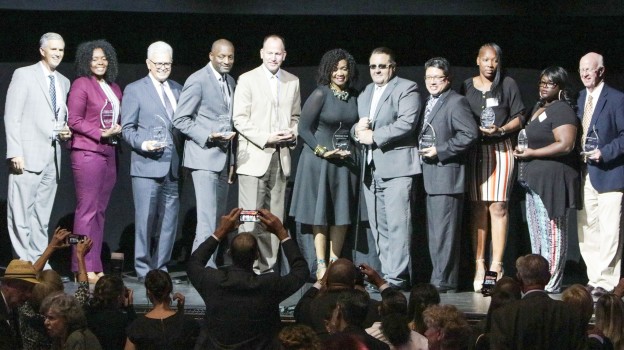
RideKC Combats Rising Temperatures with Cooling Bus
RideKC will host a cooling bus at the 10th and Main Transit Center from 11:15 a.m. to 6 p.m. today to help customers beat the heat. Temperatures are forecast to exceed 100 degrees today. When temperatures soar above 100 degrees, RideKC dispatches a cooling bus at 10th and Main. When temperatures drop below 10 degrees, a heating bus is stationed at the same location.
Passengers will not be charged a fare to board the cooling bus.
Free RideKC Shuttles Will Move Thousands of KC Air Show Fans
Buck O’Neil Bridge closed to all vehicles except RideKC Shuttles
(Kansas City, Mo. I July 5, 2019) - RideKC shuttles will transport thousands of fans to the 2019 KC Air Show on Saturday, July 6 and Sunday, July 7 at the Charles B. Wheeler Downtown Airport. The free shuttles will start at 8 a.m. and will continue until 6:30 p.m. on both days. Shuttles will arrive and depart from three free parking locations, 7th and Baltimore (J.E. Dunn Garage), Hy-Vee Arena (old Kemper Arena) and 11th and Oak (Ed Wolf Garage). There will be volunteers stationed at each location to help fans navigate to the Air Show using the shuttles.
The Buck O’Neil Bridge will be closed to all traffic and only RideKC shuttles will be able to drive over the bridge. RideKC is providing 80 air-conditioned buses for shuttles. Please plan to arrive at the shuttle locations early as there may be long lines waiting to load the buses. The Downtown Streetcar will be running during the event. Attendees can use the North Loop stop at 7th and Main to exit the KC Streetcar and get on the shuttle at 7th and Baltimore. Downloadable maps of the parking locations are available on the KC Air Show website.
Gates open at 9 a.m. on both show days. Aerial performances are scheduled to start at approximately 10:30 a.m. Gates will close at approximately 5 p.m. each day.
The famed Blue Angels are performing, as well as the U.S. Army Golden Knights, A-10 Demo Team, Patty Wagstaff, Julie Clark, and many more. Fans will see two days of world-class aerobatic performances, military jet demonstrations and thrilling entertainment for the entire family.
RideKC Cuts Route to Southwest Johnson County
RideKC will eliminate the 596 3-Trails-Edgerton route, which takes passengers from south Kansas City, Mo. to southwest Johnson County, Kan., on July 1, 2019. The Kansas Department of Transportation (KDOT) grant that funded the route during its first year of operation will end and no new funding has been identified.
“The 3-Trails-Edgerton route was a partnership with KDOT using one-time funding to explore the demand for commuter transit service in an area not previously served,” said Josh Powers, business liaison for Johnson County. “Now that the pilot has ended, the ridership wasn’t sufficient to include the route as a permanent part of our system.”
Service to Gardner, Kan., and Edgerton, Kan., will still be provided by the 595 Gardner-OP Express route. This route is accessible from 3-Trails Transit Center by taking either the Troost MAX to downtown Kansas City or by taking the 75 75th Street route to the Waldo MAX station (Broadway at 74th Terrace) and then either the 475 Quivira-75th Street or the 495 95th Street to Oak Park Mall. These options will significantly increase travel time for passengers currently using the 596 route from 3-Trails Transit Center.
KCATA Launches System Redesign Asks Community to Take Survey
The Kansas City Area Transportation Authority (KCATA) has initiated one of the largest system redesigns – RideKC Next – in the agency’s history. The goal of the project is to make sure the network reflects the needs, priorities and values of the people who live and work in Kansas City today.
“This system redesign differs from past initiatives as it will draw from a menu of mobility options, not just bus service,” said Robbie Makinen, president and CEO of KCATA. “This first step is the community’s opportunity to take a survey that will help KCATA build an innovative transit network for the next 20 years, not the last 20.”
The RideKC Next project includes an analysis of current transit operations’ efficiency and effectiveness, consideration of new mobility options, a look at public/private partnership opportunities, and public outreach and engagement.
RideKC Next has three steps. Step one is to review existing transit service and conduct initial public outreach. An online survey is vital to this process and will help shape options for the future. Residents can take the survey in English or Spanish at ridekcnext.org through July. The survey takes less than 10 minutes to complete.
Step two is presenting the draft plan and seeking additional public comment.
Step three is submitting the final plan to KCATA for review and approval by the Board of Commissioners.
For more information about RideKC Next, please visit http://ridekcnext.org/. To request a printed copy of the survey call 816-346-0300 or email .(JavaScript must be enabled to view this email address).
KCMO Voters Can Ride to the Polls for Free on June 18
RideKC is offering voters heading to the polls in Kansas City, Mo., free rides on election day June 18, 2019.
Fares on KCATA RideKC bus routes serving Kansas City, Mo., will be free all day. KCATA paratransit offered by KCATA will also be free to ride.
To find your polling place and check your voter status, Kansas City residents in Jackson County can visit the Kansas City Election Board website, [url=http://www.kceb.org/]http://www.kceb.org/[/url]. For other locations in Missouri, start with the Secretary of State’s website, [url=http://www.sos.mo.gov/elections/govotemissouri/]http://www.sos.mo.gov/elections/govotemissouri/[/url].
Customers can plan their travel early. For help planning your trip, call 816-221-0660 and be ready to provide the starting address and the address of your polling place. Customers can also plan a trip with Google Transit trip planner, available on the home page of RideKC.org. The Regional Transit Call Center is also open weekdays from 6 a.m. to 7 p.m
May 28: Pride + RideKC = PrideKC
Media Alert
The RideKC transit team is showing off their pride this June
WHAT: During the month of June, RideKC will be PrideKC as we invite you to ride along on the PrideKC vehicles and celebrate diversity, inclusion and safety all month long.
PrideKC will kick-off with an event that will unveil the PrideKC illustrated public transit vehicles, as well as have music, refreshments, photo opportunities with the rainbow-wrapped vehicles, free on-site health assessments, PrideKC details and future events, and how you can get involved. Limited edition PrideKC swag will also be available for purchase.
WHEN: The PrideKC kick-off is Tuesday, May 28, 2019, from 11:30 a.m. – 1:30 p.m. The event is open to the public and will take place rain or shine.
WHERE: The Union Station KC Streetcar stop on the west side of Main Street and north of Pershing Road.
WHO: Special guests include members from the Office of Congressman Cleaver and the Office of Congresswoman Sharice Davids, Mayor Sly James, City Councilmembers, the Kansas City Health Department, the Mid-America LGBT Chamber of Commerce, KC Regional Transit Alliance, PrideKC sponsors, RideKC team members and many more.
WHY: The month of June is celebrated nationally as Pride Month for the LGBTQIA+ community, as well as Safety Month through the National Safety Council. We want to share the message that RideKC welcomes everyone and strives to provide a safe and inclusive place for our employees, customers and region. We stand together against violence and discrimination based on gender, sexual orientation, race or religion, and work together to make all modes of transportation a safe and enjoyable experience.
PrideKC is made possible by the generous support of our local sponsors and community partners: The Mid-America LGBT Chamber of Commerce; KC Regional Transit Alliance; Burns & McDonnell; PortKC;HNTB; Quintessential Events; River City Rebar; WeWork; WSP; TranSystems; and TREKK Design Group. A special thanks to Union Station for helping to host this event.
For PrideKC media inquiries, please contact .(JavaScript must be enabled to view this email address). The KC Streetcar is online at www.kcstreetcar.org. Also visit RideKC at www.ridekc.org.
RideKC Expands Free Student Pass Pilot Program to North Kansas City
The Kansas City Area Transportation Authority (KCATA) is expanding its Student Pass pilot to the four North Kansas City High Schools starting in the Fall of 2019. KCATA will welcome the new school district to the program in a pep-rally style news conference at 1 p.m. on Tuesday, May 14, 2019, at Oak Park High School at 825 NE 79th Terr., Kansas City, Mo. 64118. The Student Pass Program kicked off last year with three school districts south of the river. Due to its success, the program will now expand to Oak Park, Winnetonka, Staley and North Kansas City high schools.
“Talent knows no zip code; but opportunity does,” said Robbie Makinen, CEO of KCATA. “We want students to have access to transit whether they live north or south of the river. They all deserve access to transit.”
The pilot partnership between KCATA, Kansas City Public Schools, Hickman Mills C-1 School District and Center Public School District will continue for the upcoming school year. High school students in the pilot program took 40,000 trips so far.
“We are so excited about this partnership with KCATA. This will open up a variety of opportunities for many NKCS students for whom transportation may have been a barrier,” said Dr. Dan Clemens, Superintendent North Kansas City Schools. “The student bus pass program will be another tool our students can use to further their success in our district and beyond.”
For more information regarding RideKC service, please visit RideKC.org. If you have questions about your student’s participation in the program, please contact your school.
Is North Oak Ready for MAX? RideKC Seeks Customer Input
Note: The outdoor meeting for Wednesday evening, May 8, at Boardwalk Square has been CANCELED due to predicted storms.
RideKC is giving riders the opportunity to help shape the future of transit on North Oak in a series of pop-up meetings this month. Feedback given at the upcoming meetings will help shape the North Oak Study which will give recommendations on how transit can better serve the North Oak Corridor and surrounding neighborhoods from downtown Kansas City, through North Kansas City and Gladstone.
The study will consider the feasibility of a MAX-level transit investment in the corridor. MAX is RideKC’s Bus Rapid Transit (BRT) service that includes high service levels, increased rider amenities, and rail-like stations. There is currently a Main MAX, Troost MAX and Prospect MAX is under construction.
Customers can give their feedback at one of the following three sessions.
Thursday, May 2, 4:30-6:30 p.m. at North Kansas City YMCA, 1999 Iron Street, North Kansas City, Mo.
Saturday, May 4, 11:30 a.m. - 1:30 p.m. at Gladstone Community Center, 6901 N. Holmes, Gladstone, Mo.
CANCELED due to weather: Wednesday, May 8
For more detailed information or to provide feedback, attend one of the meetings, call 816-346-0300, or email .(JavaScript must be enabled to view this email address).
RideKC Promotes National Get on Board Day with Free Giveaways
National Get on Board Day is Thursday, April 25, 2019 and RideKC is asking passengers to join in the activities and win some RideKC swag at various locations between 11:30 a.m. and 1:30 p.m.
RideKC is setting up four locations along the Streetcar line where riders can pick up cards and collect stickers. Passengers can use the Streetcar or take a RideKC bus to get stickers at the following locations:
RideKC Bus and MAX will be at 3rd & Grand
RideKC Bike will be at Union Station
RideKC Streetcar will be at Union Station
Once all the stickers are collected, passengers turn in the card at one of the stations to win cool RideKC swag. Employees will be at each location to show customers how to ride, how to use the bike racks on the buses, and they’ll be there to answer transit-related questions and help with trip planning.
National Get on Board Day is a day that encourages people to support public transportation and showcases the benefits it brings to communities. 34 million people use public transportation every weekday across the country.
“We support National Get on Board day and its goal of showing how important transit is to communities,” said Robbie Makinen, CEO of KCATA. “It’s about more than just putting buses on the streets; we want to continue to help change the lives of veterans, students and to connect people to opportunities.
Across the region, RideKC provides local and express routes, on-demand, bus rapid transit, paratransit, and micro transit service. RideKC operates 79 bus routes and one streetcar line providing 14 million passenger trips across the region.
“We are encouraging everyone to get on board with public transit,” said Tom Gerend, executive director with the KC Streetcar Authority. “Public transit is about connecting people to their community, employment, activity centers and opportunities. Public transit gives people the freedom to explore the Kansas City region whether by KC Streetcar, bus or bike,” continued Gerend.
For more information on National Get on Board Day check out APTA.com.
KCMO Voters Can Ride to the Polls for Free on April 2
Voters heading to the polls in Kansas City, Mo., can catch RideKC transit for free on April 2, 2019, for the City’s elections.
“Exercising the right to vote is so important that we want to make it as easy as possible to get to the polls,” said KCATA President and CEO Robbie Makinen. “It’s about connecting people to opportunities, including the opportunity to vote for candidates that will ultimately affect their future.”
On Election Day, fares on KCATA RideKC bus routes serving Kansas City, Mo., will be free. KCATA paratransit offered by KCATA will also be free to ride.
To find your polling place and check your voter status, Kansas City residents in Jackson County can visit the Kansas City Election Board website, [url=http://www.kceb.org/]http://www.kceb.org/[/url]. For other locations in Missouri, start with the Secretary of State’s website, [url=http://www.sos.mo.gov/elections/govotemissouri/]http://www.sos.mo.gov/elections/govotemissouri/[/url].
Customers can plan their travel early. For help planning your trip, call 816-221-0660 and be ready to provide the starting address and the address of your polling place. Customers can also plan a trip with Google Transit trip planner, available on the home page of RideKC.org. The Regional Transit Call Center is also open weekdays from 6 a.m. to 7 p.m.
RideKC Welcomes Grandview to the Regional Transit System
RideKC will welcome the City of Grandview to the regional transit system at a kickoff event for the start of new service extending into Grandview on Monday, April 1, 2019, at 10 a.m. in the parking lot of the Burlington store of Truman’s Marketplace at 12400 15th Street.
Kansas City Area Transportation Authority (KCATA) CEO Robbie Makinen, KCATA Board Vice-Chair David Bower and Grandview Mayor Leonard Jones will attend the official “opening day” of the 29 Blue Ridge Limited, which extends service into Grandview as part of a pilot program.
“This new express route connects Grandview residents to opportunities throughout the region,” said Makinen. “This partnership is yet another positive move for regional transit taking place throughout our bistate area.”
The extension will run northbound to Downtown Kansas City and southbound to Grandview twice a day, Monday through Friday in the early morning and late afternoon. Buses run every 30 minutes.
Grandview Public Works Director Dennis Randolph applied for the $250,000 grant that will fund the extended route for three years.
"In building a sustainable community we need to provide for a variety of means of transportation, which is exactly what we're doing," explains Randolph.
Grandview destinations include Truman's Marketplace, Mid-Continent Public Library and City Hall.
Travel Downtown All Day for 3 Bucks During Big 12 Basketball Tournament
RideKC offers an all-day transit pass that lets fans travel around Downtown during the Big 12 tournament at the Sprint Center, 1407 Grand for just $3. Fans can take the Main MAX from Crown Center, Westport, The Plaza and Waldo and ride to the Sprint Center for $3 all day from March 13 -16. Fans will get to ride the new Main MAX buses featuring new lighting, vinyl seats, USB charging ports and monitors.
RideKC has three fare options. Regular fare is $1.50 per ride and includes a free two-hour transfer on request. An all-day pass costs $3 and can be purchased on the bus. Three-Day Visitor Passes are available for $8 at KCATA offices, 1200 E. 18th Street. You can pay your fare with the RideKC app, available in the Apple app store and in Google Play.
Main MAX will take fans to the Sprint Center on Northbound buses from Crown Center, Westport, The Plaza and Waldo. The drop off is at 12th & Grand. Southbound buses from 3rd & Grand will stop at 11th & Grand.
Due to the closure of Grand at Sprint Center, several bus routes will detour to Oak, including Main MAX. Details are available on the RideKC website.
For further information, visit us online at [url=http://www.RideKC.org]http://www.RideKC.org[/url] or call the Regional Call Center at (816) 221-0660 weekdays from 6 a.m. to 7 p.m.
Free Fares For Furloughed Workers End February 15, 2019
Kansas City Area Transportation Authority (KCATA) announces it will end free fares for furloughed federal government workers on February 15, 2019. The KCATA started the free fares on Jan. 14, 2019. Approximately 1,300 rides were taken by furloughed government employees affected by the shutdown.
KCATA Board of Commissioners Elects Officers
(Kansas City, Mo. I Jan. 31, 2019) The Board of Commissioners of the Kansas City Area Transportation Authority (KCATA) elected new officers and welcomed a new commissioner at the Jan. 30, 2019 board meeting. The commissioners re-elected Daniel Serda and David Bower to serve as Chairman and Vice Chairman respectively. Melissa Bynum will serve as Treasurer and Anne Post was elected Secretary. Commissioners are nominated at the end of the year and officially elected in January of each year.
Attorney Louie Wright Replaced Judge Sims
Louie A. Wright has been appointed to represent Clay County, Missouri on the KCATA Board, replacing retiring commissioner Judge Thomas E. Sims.
Wright operates his own law practice, Wright Law Offices, LLC, and is an Adjunct Professor at UMKC School of Law, where he teaches Labor Law. He is admitted to practice law in Missouri, Kansas and Colorado, and focuses on labor law and negotiations.
Currently, he is General Counsel to Local No. 42 of the International Association of Firefighters that represents public employees in twelve separate political subdivisions. Wright is currently Chair of Kansas City’s Health Care Trust and the City’s Workers’ Compensation Board. He also serves on the Firefighters’ Pension Board.
Wright holds a master’s degree in Public Administration from Harvard University’s John F. Kennedy School of Government. He also holds a Juris Doctor (with Distinction) from the University of Missouri - Kansas City School of Law.
Wright is retired from the Kansas City Fire Department and previously served as the President of Local No. 42. He also served on the IAFF International Executive Board until 2008 representing members in Missouri, Iowa, Nebraska and Kansas; and he has also served on the Executive Boards of the Greater Kansas City AFL-CIO and the Missouri AFL-CIO.
Wright resides in Kansas City, Missouri, with his wife Melinda. He has two adult children who both live in New York City.
KCATA is governed by a 10-member Board of Commissioners, five from Missouri and five from Kansas. Commissioners are limited to two consecutive four-year terms. Responsibility for the management, control and operation of the Authority and its properties is vested in the Board. The Board exercises its responsibility by adopting all general policies of the Authority, including the adoption of annual capital and operating budgets, the establishment of the goals of the Authority, and the selection of a CEO. The Board may delegate certain duties and responsibilities to the CEO for the management and operation of the Authority.
KCATA Honors 76 Bus Operators for Distinguished Service
(Kansas City, Mo. I Jan. 31, 2019) The Kansas City Area Transportation Authority (KCATA) will honor 76 bus operators for keeping passengers safe and providing excellent customer service during the annual Distinguished Driver Awards on Feb. 1, 2019, at 11:30 a.m. and 2:30 p.m. at 1350 E. 17th St.
(Media should check in with the guard post to receive instructions on where to go.)
This year’s winners will receive awards for having no avoidable vehicle or passenger accidents. The operators also exhibited great customer service and received no write-ups or suspensions. They also had good attendance and arrived on time for work every day.
The Distinguished Drivers ceremony honors operators in several categories listed below.
2018 Meritorious Driver -This operator has earned distinguished driver status for 15 years.
- Gary Blaylock
2018 Grand Master Drivers - These two operators earned Distinguished Driver status for 10 years.
- Laverne White
- Regina Miller
2018 Master Drivers – These operators earned Master Driver status for five years.
- Michael Kolie
- Brian Dyer
- Geran McConnell
- Michael Barton
- Brenda Hinton
68 other operators will be awarded the Distinguished Driver award.
KCATA CEO Robbie Makinen and other management staff will address the award winners.
RideKC Celebrates First New Route in Kansas City, Kansas in Over a Decade
RideKC will hold a Ribbon Cutting Ceremony for the new 118 18th Street Route on Jan. 8, 2019, at 10 a.m. in front of Fast Fred’s Supermarket at 1806 N. 18th Street to celebrate the first new transit service operated by the Unified Government (UG) of Wyandotte County/Kansas City, Kan., in over 10 years.
The route started Jan. 2, 2019 and is the first all-day route from Kansas City, Kan., to Johnson County, Kan. It gets passengers from Quindaro Blvd. to 51st Street in Roeland Park in under 25 minutes. The bus runs hourly, every weekday from 5:30 a.m. to 7:30 p.m.
Mayor David Alvey, Unified Government of Wyandotte County/Kansas City, Kan., UG Commissioner Harold L. Johnson, Jr., UG Commissioner Melissa Bynum and KCATA CEO, Robbie Makinen, will be available for comment at the ceremony.
“This historic new route is the result of a strong RideKC partnership committed to connecting people to opportunities,” said Makinen. “For the first time in over a decade, thousands of people along the route will now have fast, frequent and efficient access to jobs.”
The new route will impact over 14,000 people who live within a quarter-mile of the route and will be a transit option for over 5,000 thousand jobs located within a quarter-mile of the route.
For media questions, contact Petrina Parker, Public Information Officer, at 816-946-0708 or .(JavaScript must be enabled to view this email address).
Get Home Safe for Free With RideKC On New Year’s Eve
Celebrate New Year’s Eve and get home safe with a free ride on any RideKC bus from 4 p.m. Monday until service ends after midnight.
Fares on all RideKC bus routes serving Kansas City, Johnson County, Wyandotte County and Independence will be free. KCATA and Johnson County paratransit will also be free to ride after 4 p.m.
Riders can plan a trip at [url=http://www.ridekc.org]http://www.ridekc.org[/url], using the trip planner on the home page. Customers can get help planning a trip by calling the Regional Call Center at 816-221-0660, weekdays from 6 a.m. to 7 p.m.
RideKC Announces Thanksgiving Holiday Events Reroutes
(Kansas City, Mo. – Nov. 19, 2018) RideKC will operate on a Sunday/Holiday schedule for Thanksgiving, Thursday, Nov. 22. The Kansas City Area Transportation Authority’s Regional Call Center, administrative offices and customer service lobby also will be closed for Thanksgiving. KC Streetcar will operate from 7 a.m. to 10 p.m. on Thanksgiving. Buses operated by Johnson County, Independence, Mo., and Unified Government Transit will not offer service on Thanksgiving. Regular weekday service will resume Friday, Nov. 23, for all RideKC service. Schedule details are available at [url=http://www.ridekc.org]http://www.ridekc.org[/url].
Plaza Lights on Thursday, Nov. 22
Customers can take RideKC to the Plaza Lighting Ceremony on Thanksgiving, with extra Main MAX service between downtown, the County Club Plaza and Waldo. Between 4 p.m. and 8:30 p.m., buses will run approximately every 10-15 minutes. For the rest of the day, Main MAX operates on a Sunday/Holiday schedule, providing service every 30 minutes throughout the day. The last regularly scheduled northbound bus headed toward downtown leaves the Plaza from 47th Street & Main at 12:09 a.m. The last southbound bus headed toward Brookside and Waldo leaves the Plaza from 47th Street & Main at 11:34 p.m.
Plaza service on Main MAX, 35 35th Street, and 47 Broadway will reroute around the Plaza because of expected traffic congestion. The routes will still take customers close to the lighting festivities. All of the reroutes will begin at 3 p.m. and end when traffic clears. See [url=http://www.ridekc.org]http://www.ridekc.org[/url] for detailed information about the reroutes.
Mayor’s Christmas Tree Lighting on Friday, Nov. 23
On Friday, Nov. 23, bus routes that usually serve Crown Center via Grand will be rerouted from 4:30 p.m. to 8 p.m. due to the Mayor’s Christmas Tree Lighting Ceremony. The lighting ceremony starts at 5:30 p.m. Customers can call 816-221-0660 to find a nearby bus stop.
Bus service that will be rerouted include Main MAX, 23 23rd Street, 27 27th Street, 47 Broadway, 51 Ward Parkway, 77 Casino Cruiser, 85 Paseo, 201 North Oak, 404 Metcalf-Downtown, 519 Olathe Express, 535 Shoal Creek/Liberty Express, 550 Lee’s Summit Express, 563 Shawnee Express, 569 South OP Express, 570 Blue Springs Express, 571 71 Hwy Express, and 595 Gardner-OP Express.
For more information, customers may call the Regional Call Center at 816-221-0660 weekdays from 6 a.m. to 7 p.m.
New RideKC Student Pass gives students free, unlimited access to the region
Free bus rides will link students to job centers and after school activities
Kansas City, Mo. | Oct. 29, 2018 – The Kansas City Area Transportation Authority (KCATA) and three area school districts will announce a new Student Pass Program that will give thousands of ninth through 12th graders free, unlimited access to public transportation throughout the region. The pep-rally style news conference starts at 3 p.m. on Oct. 30, 2018 at Manual Career Tech Center at 1215 E. Truman Road.
The partnership between KCATA, Kansas City Public Schools, Hickman Mills C-1 School District and Center Public School District is a one-year pilot, designed to enhance current school bus transportation and allow students to connect to opportunities for jobs, internships and extra-curricular activities outside of regular school hours.
“The KCATA is committed to breaking down barriers to learning and accessing jobs for our kids,” said Robbie Makinen, KCATA President and CEO. “Students will be able to attend school sporting events and get to jobs or tutoring without the expense of a car or relying on a parent for a ride.”
Missouri State Senator, Shalonn “KiKi” Curls, said the program will help students connect with academic and after-school programs they may not otherwise get to experience.
“We know there are students who want to get involved in after-school activities that will help them to be successful in their goal to graduate,” said Senator Curls. “This unique program knocks down one of the barriers that has kept many scholars from participating because now they will have easier access to transportation to get to those school activities and educational opportunities.”
Dr. Mark Bedell, Superintendent Kansas City Public Schools, believes the initiative will provide students with greater academic and professional opportunities.
“This is a terrific partnership between the schools and the KCATA,” said Dr. Bedell. “We are hoping more students can participate in tutoring, internships, accessing libraries and more.”
The Student Pass Program will enhance the transportation service currently offered to students to get to and from school for classes.
"I have lived in Janesville, Wisconsin where partnerships like this enhanced the school system transportation options. This one is definitely a good thing!” said Dr. Yolanda Cargile, Superintendent Hickman Mills C-1 School District. “I am excited about this opportunity, as it is one that is extremely beneficial for our students.”
Center School District is proud to be a part of the pilot and has already seen how the program can help students.
“We are beyond thrilled that the partnership with KCATA will serve our students by removing barriers and providing new transportation alternatives,” said Dr. Sharon Nibbelink, Superintendent of Center School District. “This will not only teach our students important life skills, but also provides access to internships and employment opportunities.”
Cheerleaders, a mascot and a drum line from the participating schools will bring a pep rally flair to the news conference and help get students “fired-up” to get on board with RideKC to access the entire region.
For more information regarding RideKC service, please visit RideKC.org. If you have questions about your student’s participation in the program, please contact your school.
Nation’s Top Transit Official to Attend Prospect MAX BRT Groundbreaking
Kansas City, Mo. | Oct. 24, 2018 – The Federal Transit Administration (FTA), Kansas City Area Transportation Authority (KCATA) and the City of Kansas City, Mo., will break ground on the Prospect MAX Bus Rapid Transit (BRT) project with a ceremonial groundbreaking at 10 a.m. Thursday, Oct. 25, at 12th and Charlotte streets (southeast corner). The location is the future home of the East Village Transit Center, which is part of the $55.8 million Prospect MAX BRT project that will bring enhanced transit service to Prospect Avenue.
Prospect MAX BRT will be the third Bus Rapid Transit line to serve the Kansas City region. The Prospect MAX BRT route will cover nearly 10 miles from Downtown Kansas City to 75th Street with stations every four to six blocks. The new BRT line will enhance the transit experience for existing riders by offering more frequent service, traffic signal priority, fewer stops, free public WiFi and uniquely branded red buses.
Event speakers include K. Jane Williams, FTA acting administrator; Sly James, mayor, Kansas City, Mo.; and Robbie Makinen, KCATA president and CEO. The FTA approved nearly $30 million for the project.
“The U.S. Department of Transportation, under the leadership of Secretary Elaine L. Chao, supports Kansas City and KCATA as they work to bring more efficient bus services to connect residents to work, school, and other destinations,” said Williams.
Prospect MAX BRT hopes to achieve the same economic development successes seen on the Main MAX and Troost MAX lines. When construction is done, the Prospect MAX corridor will have improved streets, sidewalks and traffic signals, and a better pedestrian experience.
“We’re so grateful for the support of the Federal Transit Administration and the City for making transformational projects like this possible,” said Makinen.
The first major construction project of the Prospect MAX BRT line is the East Village Transit Center. It will be the region’s premiere mobility hub, offering improved daily connections for thousands. Its unique features include level boarding, interactive real-time signs and smart kiosks, enhanced pass purchasing, indoor seating and an enhanced security presence. The transit center will provide improved regional access for those working, living or playing downtown with convenient connections to RideKC’s regional transit services for pedestrians, bicyclists, those using electric scooters and passengers transferring between routes.
MAX is RideKC’s brand of Bus Rapid Transit. KCATA operates two MAX BRT lines: Main MAX (opened 2005) and Troost MAX (opened 2011). Prospect MAX is projected to be complete in the fall of 2019.
RideKC Freedom On-Demand expands into Independence, Mo.
Kansas City, Mo. | Oct. 8, 2018 - The Kansas City Area Transportation Authority (KCATA), in cooperation with the City of Independence, Mo., is proud to announce the expansion of RideKC Freedom On-Demand paratransit services in Independence.
“We have had great success with our RideKC Freedom On-Demand in Kansas City and this is another step toward regional, comprehensive mobility services,” said Robbie Makinen, President and CEO, KCATA. “It further drives home the idea that building great value-added services for our riders and community partners will drive public transit success in the region.”
RideKC Freedom On-Demand launched in parts of Kansas City, Mo., and northeast Johnson County, Kan., in May 2017. It has expanded to Wyandotte County and Johnson Counties in Kansas since then, and has provided more than 90,000 trips for people with disabilities. Now with the expansion into Independence, RideKC Freedom On-Demand can provide paratransit users with even more options.
Ridership for Freedom On-Demand continues to grow. By the end of November, RideKC Freedom On-Demand is on track to surpass 100,000 rides. The expansion doesn’t just give users more options, but allows the KCATA to continue building on robust, innovative partnerships that drive the region forward.
“The City of Independence takes care of our people, and we are always looking for ways to improve our residents’ quality of life. Our partnership with KCATA allows us to provide Freedom On-Demand service to residents of Independence,” said Mayor of Independence Eileen Weir. “This will provide another option for riders to travel around the city.”
Riders can download the RideKC Freedom App at http://ridekc.org/mobility-services/ridekc-freedom-ondemand, or call 816-842-9070 to learn more and book a trip.
Kansas City Region Offers Free Rides on Election Day, Nov. 6
(Kansas City, Mo. – Oct. 8, 2018) RideKC routes will offer free fares all day on Nov. 6 to make it easier for citizens to vote.
Download a Resource Guide for help voting and riding.
“Exercising the right to vote is so important that we want to make it as easy as possible to get to the polls,” said KCATA President and CEO Robbie Makinen. “We are grateful to our regional transit partners in Johnson County, Independence and KCK for agreeing to again make this a truly regional transit initiative.”
On Election Day, fares on all RideKC bus routes serving Kansas City, Johnson County, Wyandotte County and Independence will be free. KCATA, Johnson County and Independence paratransit will also be free to ride.
The deadline to register to vote is fast approaching. People in Missouri need to register or update their voter registration by Wednesday, Oct. 10. The deadline for Kansas is Oct. 16.
To find your polling place and check your voter status, Kansas City residents in Jackson County can visit the Kansas City Election Board website, http://www.kceb.org/. For other locations in Missouri, start with the Secretary of State’s website, https://s1.sos.mo.gov/elections/voterlookup/.
In Kansas, Johnson County voters can access resources at Johnson County Election Office, https://www.jocoelection.org/default.htm, and Wyandotte County election information is available at Wyandotte County Election Office, http://www.wycokck.org/election/. The above websites can provide more details. For those who live elsewhere in Kansas, information is available at Vote Kansas, http://www.voteks.org/.
Customers can plan their travel early. For help planning your trip, call 816-221-0660 and be ready to provide the starting address and the address of the polling place you will be traveling to. Customers can also plan a trip with Google Transit trip planner, available on the home page of RideKC.org. The Regional Call Center is also open weekdays from 6 a.m. to 7 p.m.